Follow the yellow brick road – or, why I loved third grade

A couple of weeks ago I got this message through my blog:

I am trying to do a follow up on my students from PS 166 class 3-305.
I believe that I have found you. I am extremely proud of all your accomplishments. Please email me back with an update.
I would love to meet with you to discuss old times.

It was my third grade teacher! How cute is that?  Suddenly I felt like I was nine years old again, learning my multiplication tables and playing the recorder.  Third grade was a very good year…

So we met for lunch in the city the following week and reminisced about old times.  She looked the same except she had straight hair instead of the reddish curls I remember.  It was so weird to be sitting next to her as an adult!

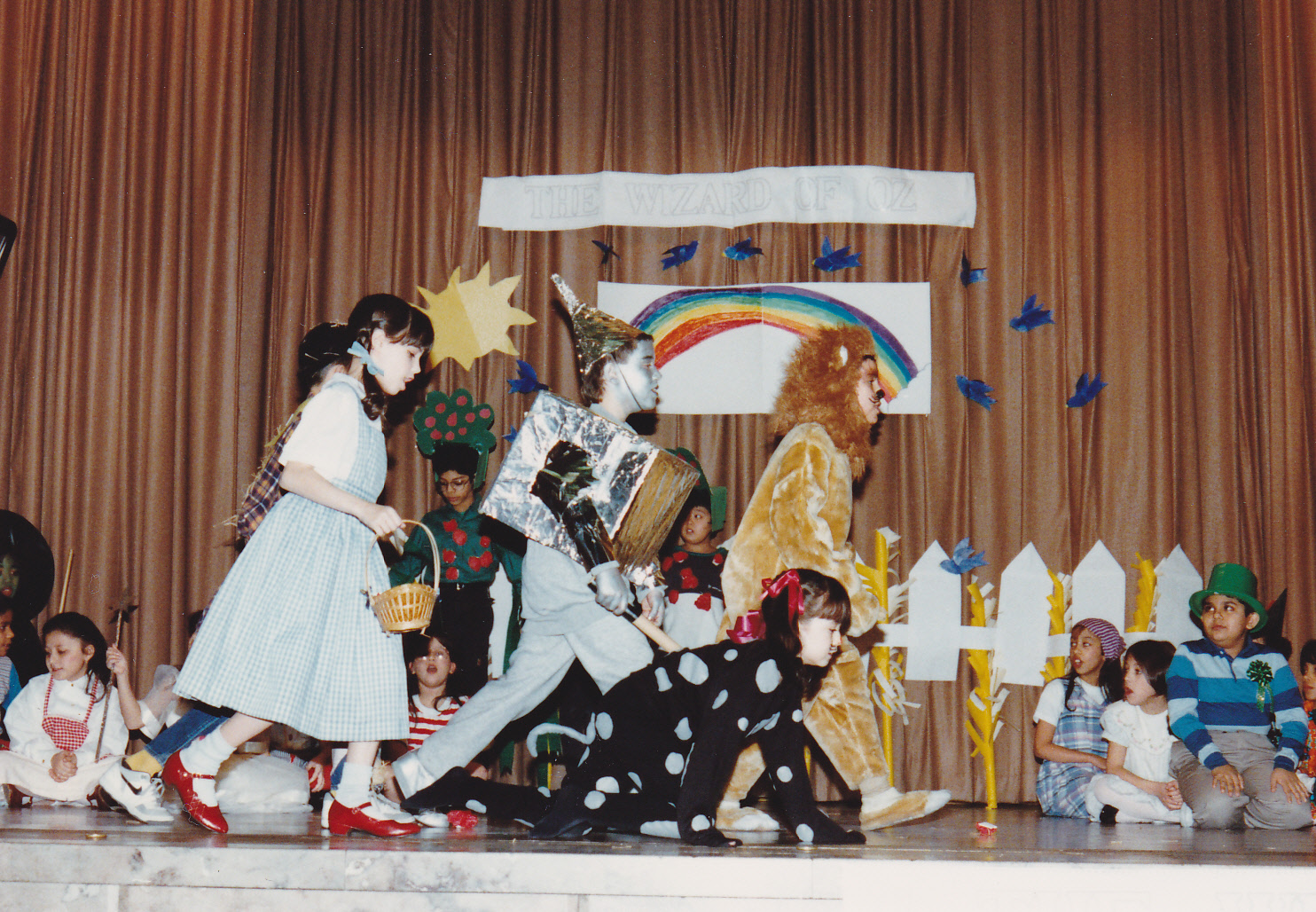
We had both brought pictures from the defining event of that year: the production of The Wizard of Oz we put on.  I played Dorothy. Actually, I was one of two Dorothies. My voice was too small and quiet to hold up for the entire show, so it was decided that another girl would play the lead for the second half.  I was “Dorothy #1.” 🙂

Follow the yellow brick road! I still have one of those paper corn stalks from the set in my closet. I am such a hoarder.

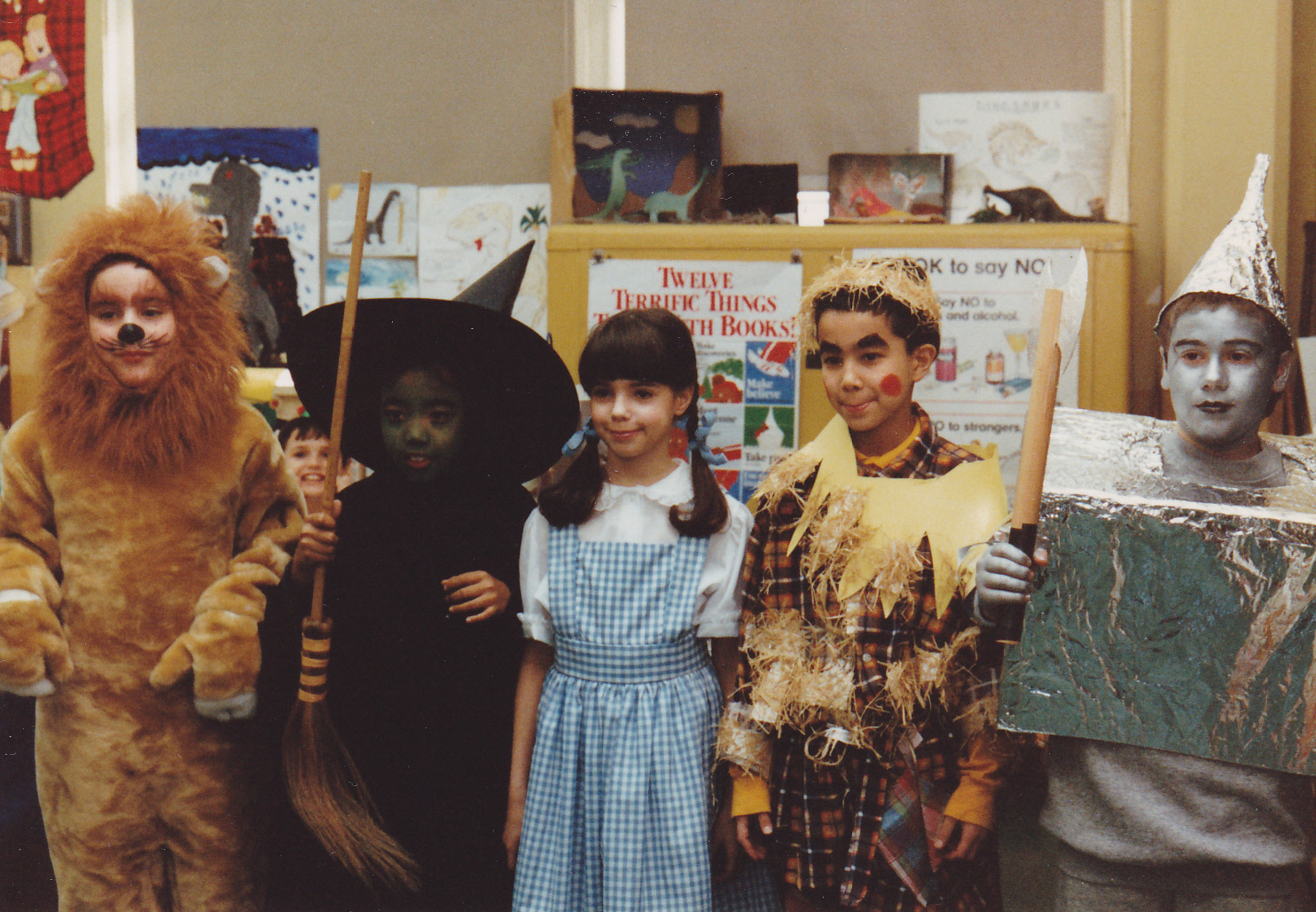
From left to right, Clint Borzoni, Armita (?), Stefanie Weisman, Danny Ho, Michael Petrocelli. I still remember their names! We had such amazing costumes. (I love the dinosaur dioramas in the background, too.)

Me as Dorothy, with the Lion and Tin Man in the background. I love the tree costumes!

We had really great costumes, most of them hand-made. My mother sewed this Dorothy costume from a pattern she got at the Five and Dime – can you believe it?

My former teacher said that it got harder and harder for her to put on plays like this as the pressure to teach for standardized tests mounted.  What a shame.  This was one of the defining moments of my childhood, and you can see how much love and care we put into this play.  More kids should be given this opportunity.

It’s official – I have a book contract!

I recently signed with Sourcebooks, Inc., and I couldn’t ask for a better publisher for my book, tentatively titled Rise to the Top: The Valedictorian’s Guide to Academic Success in High School and College.  My book will be in excellent company – Sourcebooks is also the publisher of Harlan Cohen’s The Naked Roommate (the #1 book on college life with over 125,000 copies sold), Christie Garton’s U Chic, the Fiske Guides, the Gruber Test Prep series, and much, much more. Check out their book list here.

It’s been a lifelong dream of mine to publish a book, and I hope this is the first of many. I’m thrilled to be able to share my study techniques with high school and college students across the country. None of this would have been possible without my wonderful agent, Coleen O’Shea, and my friends and family – thank you, thank you, thank you!!! I am in extreme writing mode right now, and I love it. To read more about my book (and to sign up for my book list and contest), please go here.

Picture of Stefanie Weisman

What’s the point of a college education?

There have been a lot of articles questioning the value of a college education recently – particularly the value of a liberal arts education. Take, for example, Frank Bruni’s The Imperiled Promise of College and Michelle Singletary’s Not All College Majors Are Created Equal. These articles warn against choosing majors that tend to result in low-paying jobs (or no jobs at all). That’s why I was glad to read Alina Tugend’s article Vocation or Exploration? Pondering the Purpose of College, which argues that college students can and should study the humanities. As Ms. Tugend writes, the question is this: is the purpose of college to “ensure a good job after graduation,” or “to give students a broad and deep humanities education that teaches them how to think and write critically? Or can a college education do both?” I’m going with door number three.

In the article, Ms. Tugend notes that what students major in has a greater impact on their future earnings than in previous decades.

So does that mean I should urge our son to pursue a degree he doesn’t have any interest in because it may provide him with a higher-paying job — or any job, for that matter — after college?

No, Professor Carnevale said, because if you don’t like what you do, you won’t do it well. The point is that “young people now need to have a strategy,” he said. “If you major in art, realize you will have to get a master’s degree. The economic calculus has changed.”

I like that line – if you don’t like what you do, you won’t do it well.

When I was in college, my most rewarding classes were in the humanities. I specialized in medieval history and got an M.A. in Art History before I majored and got a job in Computer Science. Do I regret studying history and art history, where job options are extremely limited? Not in the least. I’m glad I have a background in the humanities – I think it makes me a more well-rounded, knowledgeable, appreciative person. (However, I’m lucky that I didn’t go into debt to get my degrees. If I did owe lots of money, perhaps I wouldn’t be so pro-liberal arts.) One of the best things about Columbia, my alma mater, is that it has a Core Curriculum. All undergrads, no matter what their major, are required to take classes like Literature Humanities and Contemporary Civilization, where they have literally hundreds of pages of reading each week on everything from Homer to Dante to Freud. This was probably the highlight of my academic career.

Lastly, I was quoted in a Crain’s New York Business article last week – Goodbye, ‘bamboo ceiling’ – Corporate barriers spur Asian-Americans to start fast-growing enterprises, by Emily Laermer.

When Stefanie Weisman was Stuyvesant’s valedictorian in 1999, she said, the school was about half Asian. She described her time there as ‘the most intense four years of my life’ because of its competitiveness.

‘The students there are bright and hardworking, partly because there are so many Asian-American students,” she said, citing the influence of ‘tiger parents.’ . . . .

It’s also possible that tiger parenting ultimately backfires. Ms. Weisman, who is writing a book about academic success, said that those who enjoy learning – rather than studying because their parents insist – tend to do better professionally.


Give yourself the gift of great grades.  Order your copy of The Secrets of Top Students today!

The Black and the Gold: Computer Science Courses at Harvey Mudd College

I just read a very interesting piece in The New York Times about Maria Klawe, the president of Harvey Mudd College. Dr. Klawe and her colleagues have been trying to increase the number of female college students majoring in Computer Science – currently only 18% of CS undergrads are women. Here’s one of their initiatives:

In 2005, the year before Dr. Klawe arrived, a group of faculty members embarked on a full makeover of the introductory computer science course, a requirement at Mudd.

Known as CS 5, the course focused on hard-core programming, appealing to a particular kind of student — young men, already seasoned programmers, who dominated the class. This only reinforced the women’s sense that computer science was for geeky know-it-alls.

“Most of the female students were unwilling to go on in computer science because of the stereotypes they had grown up with,” said Zachary Dodds, a computer scientist at Mudd. “We realized we were helping perpetuate that by teaching such a standard course.”

To reduce the intimidation factor, the course was divided into two sections — “gold,” for those with no prior experience, and “black” for everyone else. Java, a notoriously opaque programming language, was replaced by a more accessible language called Python. And the focus of the course changed to computational approaches to solving problems across science.

“We realized that we needed to show students computer science is not all about programming,” said Ran Libeskind-Hadas, chairman of the department. “It has intellectual depth and connections to other disciplines.”

I really like the idea of having “black” classes for advanced students and “gold” classes for beginners, as a way of encouraging more women to go into computer science. (Plus calling it gold makes it sound better!) When I studied CS in college, I was intimidated not by the fact that the vast majority of my classmates were male, but that they had way more experience than I did. I had never even coded a “Hello world” program before, while they had been playing around with programming languages and taking computers apart since they were kids, or at least since high school. It was a huge challenge to keep up with them.

However, I also felt that my intro CS classes were much more accessible than my advanced classes, which catered even more to seasoned – and mostly male – programmers. I don’t think it would be enough to offer separate intro classes for experienced and novice students, and then throw them all together the next semester. I wonder if and how this extra support for inexperienced CS students could be continued after the intro level. I, for one, wanted a much greater variety of CS courses than were offered at Columbia. In my view, there were too many theory courses and not enough practical ones. There also weren’t enough courses that showed different ways technology could be used in society. How do you think women should be encouraged to go into computer science?

Also of interest – Ivy League acceptance rates hit an all time low this year. At Harvard, for example, it’s only 5.9%! I have two things to say about this: (1) The rise of electronic applications means that more under-qualified applicants have been applying to top schools, potentially skewing the results. (2) There are plenty of good schools out there, so don’t stress if you can’t go to an Ivy League. You’ll do fine as long as you choose a school that values education, lets you pursue your interests, and fits your budget. Good luck to all of those heading off to college next year!


Going to college?  Give yourself the gift of good grades with The Secrets of Top Students!

Hey, tigers, leave them kids alone!

I’m happy to announce that my article Taming the Tiger of Achievement is up on the New York Times blog SchoolBook.

The term tiger mother comes from Amy Chua’s book, Battle Hymn of the Tiger Mother. You’ve probably heard about the shocking techniques she used to get her kids to excel in school – such as forbidding them to go on playdates, calling them “garbage,” and demanding that they be the #1 student in every subject except gym and drama. Well, my article argues that most top students don’t have tiger mothers criticizing their every move. Their folks are supportive without being pushy. The most successful students tend to be those who are self-motivated, not forced to do things by mommy and daddy.

By the way, in this article I talk about a survey I’ve given to top students. If you or someone you know would like to participate, click here.

What do you think about the tiger mother phenomenon?


Give your child the gift of great grades.  Order a copy of The Secrets of Top Students today!


Hey all you teenage girls out there!

My study tips article “Get smart! Six ways to rock the end of the semester” is in the new issue of Girl’s Life Magazine! This is the first time I was able to walk into a Barnes & Noble and buy something with my name in it – and it’s a pretty cool feeling.

See where it says “Rock Finals!” on the right? That’s me!

In this article, I talk about easy things you can do to get better grades – things like taking naps, snacking during exams (if your teacher lets you, of course), and answering test questions out of order. In case you were wondering, I’ve used all the techniques I wrote about – and I wouldn’t have been a top student without them!

Happy studying, everyone!


Give yourself the gift of great grades.  Order your copy of The Secrets of Top Students today!

Thinking outside the box on education: 4 great books with a fresh new perspective

Some of the books with the most original, thought-provoking ideas about education these days aren’t even on education. They’re on subjects such as sociology, psychology, technology, and self-help, among others, but they challenge what’s going on in schools today. Here are some books that don’t fall into the category of education, but which have a lot to say about the way we learn.

1. Quiet: The Power of Introverts in a World That Can’t Stop Talking, by Susan Cain (Crown, 2012). This book is ammunition against a school system that increasingly views classroom education as an endless stream of group projects. While it’s important for kids to learn teamwork, all too often we forget the importance of solitude, concentration, and deep thought in the learning process. I know that when I was in school, I did my best work alone. As Ms. Cain writes:

What’s so magical about solitude? In many fields, Ericsson told me, it’s only when you’re alone that you can engage in Deliberate Practice, which he has identified as the key to exceptional achievement. When you practice deliberately, you identify the tasks or knowledge that are just out of your reach, strive to upgrade your performance, monitor your progress, and revise accordingly. Practice sessions that fall short of this standard are not only useful – they’re counterproductive. They reinforce existing cognitive mechanisms instead of improving them. Deliberate Practice is best conducted alone for several reasons. It takes intense concentration, and other people can be distracting. It requires deep motivation, often self-generated. But most important, it involves working on the task that’s most challenging to you personally. Only when you’re alone, Ericsson told me, can you “go directly to the part that’s challenging to you. If you want to improve what you’re doing, you have to be the one who generates the move. Imagine a group class – you’re the one generating the move only a small percentage of the time.” [page 81]

Another book about deliberate practice is Talent Is Overrated: What Really Separates World-Class Performers from Everybody Else, by Geoff Colvin (Portfolio Trade, 2010).

2. The Dumbest Generation: How the Digital Age Stupefies Young Americans and Jeopardizes Our Future (Or, Don’t Trust Anyone Under 30), by Mark Bauerlein. (New York: Penguin/Tarcher, 2008). The title says it all. Technology may be causing untold damage to the brains of young people. I’ve written two articles about avoiding the pitfalls of technology in education (see my piece in USA Today and the follow-up post on my blog). In this passage, Mr. Bauerlein paints a disturbing picture of this country’s rising generation of scholars:

Most young Americans possess little of the knowledge that makes for an informed citizen, and too few of them master the skills needed to negotiate an information-heavy, communication-based society and economy. Furthermore, they avoid the resources and media that might enlighten them and boost their talents. An anti-intellectual outlook prevails in their leisure lives, squashing the lessons of school, and instead of producing a knowledgeable and querulous young mind, the youth culture of American society yields an adolescent consumer enmeshed in juvenile matters and secluded from adult realities. [page 16]

There’s a book on a similar topic, The Shallows: What the Internet Is Doing to Our Brains, by Nicholas Carr (W.W. Norton & Company, 2011), which I hope to read soon.

3. Outliers: The Story of Success, by Malcolm Gladwell (New York: Little, Brown and Company, 2008). In addition to talking about the 10,000 hour rule (the theory that it takes at least 10,000 hours of practice for someone to become an expert in something), Mr. Gladwell also discusses why Asian students often outperform their American peers, especially in science and math:

We should be able to predict which countries are best at math simply by looking at which national cultures place the highest emphasis on effort and hard work. So, which places are at the top of both lists? The answer shouldn’t surprise you: Singapore, South Korea, China (Taiwan), Hong Kong, and Japan. What those five have in common, of course, is that they are all cultures shaped by the tradition of wet-rice agriculture and meaningful work. They are the kinds of places where, for hundreds of years, penniless peasants, slaving away at the rice paddies three thousand hours a year, said things to one another like “No one who can rise before dawn three hundred sixty days a year fails to make his family rich.” [pages 247-49]

4. The 4-Hour Workweek, by Timothy Ferriss (Crown Archetype, 2009). This one may be a bit of a surprise. Am I suggesting that you can get great grades by working four hours a week? Not at all. Nor am I encouraging you to outsource your schoolwork to India. But Mr. Ferriss does present some useful advice on how to work more efficiently and effectively, whether you’re a student or an entrepreneur. Here’s an example:

Parkinson’s Law dictates that a task will swell in (perceived) importance and complexity in relation to the time allotted for its completion. It is the magic of the imminent deadline. If I give you 24 hours to complete a project, the time pressure forces you to focus on execution, and you have no choice but to do only the bare essentials. If I give you a week to complete the same task, it’s six days of making a mountain out of a molehill. . . . The end product of the shorter deadline is almost inevitably of equal or higher quality due to greater focus. . . . . There are two synergistic approaches for increasing productivity that are inversions of each other:

  1. Limit tasks to the important to shorten work time (80/20).
  2. Shorten work time to limit tasks to the important (Parkinson’s Law). [page 75]

What are some of your book recommendations?


Give yourself the gift of great grades.  Order your copy of The Secrets of Top Students today!
The Benefits of Going Low-Tech in College

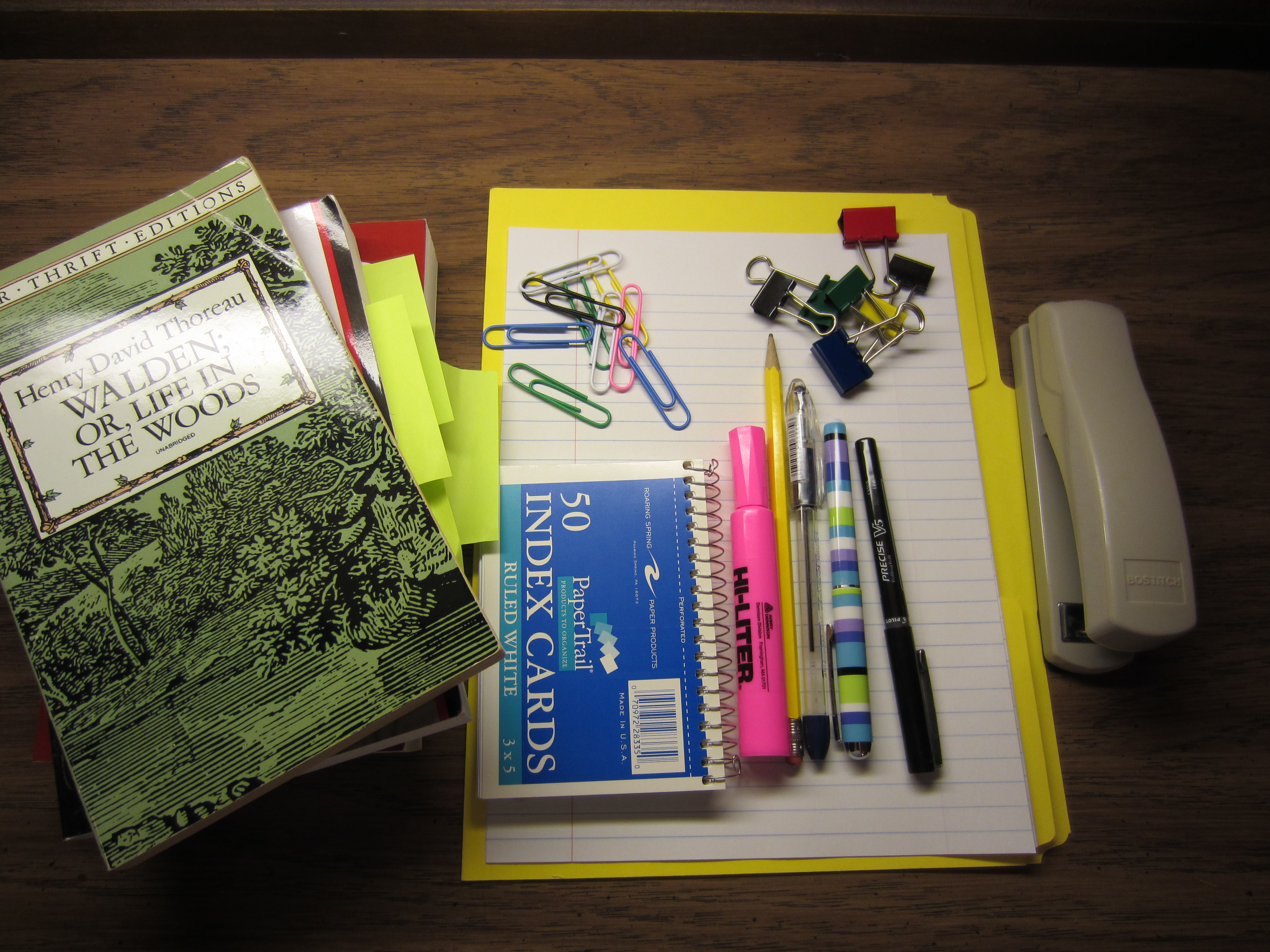
Low-tech tools

USA Today‘s College Blog just posted my article on the benefits of going low-tech in college!  In it, I explain why ditching your laptop may be good for your GPA.  There were a bunch of things I didn’t get to include in the article, though, so here’s some more advice about how to avoid the pitfalls of technology in the classroom.

      1. How to use slides.In my article, I caution against relying too much on the professor’s PowerPoint presentations, which are now commonly posted online.  But that doesn’t mean you shouldn’t use them at all – they can make taking notes easier and faster, if you use them the right way.  Here’s one way to do it:
        • If the slides are posted before class, print them out and number each one.  Bring the print-outs and a notebook to class.  Write today’s date on your slides and in your notebook.
        • Take notes directly on the slide printouts as they are covered in class.  Flesh out the slide’s outlines with details and examples provided by the professor.
        • If you run out of space on a slide printout, write that slide’s number in your notebook and continue taking notes there.  That way, when you’re reviewing, you can easily match up the slide with the relevant section in your notebook.
        • If the slides are posted after class, take notes as you normally would and use the slides as a supplement.

The benefits of paper

    1. When in doubt, print it out. Many professors have joined the environmental movement by posting syllabi and assignments online instead of printing them out.  This is all well and good for Mother Earth, but it may not be the best thing for your GPA.  If you don’t print out important documents, there’s a much greater chance that you will overlook some key detail.  I observed this numerous times in my paper-free classes.  For example, when essay assignments were posted online, many of my classmates were unaware of essentials such as the due-date and topic.  During finals, they often lost points because they hadn’t noticed certain required readings on the online syllabus.  During meetings for group projects, I was often the only one who could clarify the requirements because I had the assignment right there in front of me.  Printing out documents saves you from having to turn on your computer and navigate to your course’s web page every time you want to check something. If your conscience nags you about killing trees, remind it that you can recycle the paper when the term is over.
    2. Books aren’t dead yet. Dr. Jakob Nielsen, a web usability expert, has some alarming things to say about how technology affects reading comprehension.  “The online medium lends itself to a more superficial processing of information,” he says. “You’re just surfing the information. It’s not a deep learning.” Although reading speeds on electronic devices have improved, they’re still not as good as reading on paper: in Mr. Nielsen’s study, the iPad measured at 6.2% lower reading speed than the printed book, whereas the Kindle measured at 10.7% slower than print. And if you’re even thinking about doing serious reading on your iPhone, I have one word for you: don’t. Reading comprehension scores are 48% of the desktop level when using the iPhone-sized screen. That is, it’s twice as hard to understand complex content when reading on an iPhone versus on a full-sized computer screen.
    3. Be more independent. Lastly, this week’s Time magazine provides more evidence that we’re becoming overly dependent on technology and losing our ability to contextualize information. According to Annie Murphy Paul in the article “Your Head Is in the Cloud”

      Research conducted by Betsy Sparrow, an assistant professor of psychology at Columbia University, and published last year in the journal Science has identified three new realities about how we process information in the Internet age. First, her experiments showed that when we don’t know the answer to a question, we now think about where we can find the nearest Web connection instead of the subject of the question itself. . . . A second revelation: when we expect to be able to find information again later on, we don’t remember it as well as when we think it might become unavailable. . . . The researchers’ final observation: the expectation that we’ll be able to locate information down the line leads us to form a memory not of the fact itself but of where we’ll be able to find it.”

      Scary stuff. You can’t have an intelligent conversation if you have to look something up on your computer every 20 seconds. We must use technology with restraint, both in school and in our post-graduate lives.


Give yourself the gift of great grades.  Order your copy of The Secrets of Top Students today!
Introverts Unite!

I love the article “The Upside of Being an Introvert (And Why Extroverts Are Overrated)” by Bryan Walsh in Time magazine. I’m glad that people are finally starting to give introverts their due. I am an introvert to the extreme – I got the highest possible score for introversion on the Myers-Briggs personality test. Ten times out of ten, I would rather stay home with a good book than go to a party. That’s not to say that I’m a social outcast or don’t know how to behave around people. I just find it hard to be around large groups of people for long periods of time. I can force myself, but it’s not pleasant. I suspect that there’s a connection between introversion and academic performance. Introverts like solitude, and solitude leads to mastery of skills. As Mr. Walsh writes:

Florida State University psychologist K. Anders Ericsson believes that deliberate practice — training conducted in solitude, with no partner or teammate — is key to achieving transcendent skill, whether in a sport, in a vocation or with a musical instrument. In one study, Ericsson and some of his colleagues asked professors at the Music Academy in Berlin to divide violinists into three groups, ranging from those who would likely go on to professional careers to those who would become teachers instead of performers. The researchers asked the violinists to keep diaries and found that all three groups spent about the same amount of time — more than 50 hours a week — on musical activities. But the two groups whose skill levels made them likelier to play well enough to perform publicly spent most of their time practicing in solitude.

Unfortunately it’s getting harder and harder to escape the distractions of group work. This is true in school and even more so in the workplace. I hope that writers like Mr. Walsh and Malcolm Gladwell (who wrote about a similar subject in Outliers) will convince people of the power of being alone.


Give yourself the gift of great grades.  Order your copy of The Secrets of Top Students today!