Quick Tips Part 3: Common Grammar Mistakes All College Students Should Avoid

Make sure you know the difference between . . .

  1.  Your vs. You’re
    • “Your” is the second person possessive adjective and describes something as belonging to you.
      • Ex.: Your paper is written very well.
    • “You’re” is the contraction of “you are.”
      • Ex.: You’re going to do very well on this test.
  2. Its vs. It’s
    • “Its” is a possessive adjective meaning “of it” or “belonging to it.”
      • Ex.: I love that bakery.  Its bread is to die for.
    • “It’s” is the contraction of “it is” or “it has.”
      • Ex.: It’s also got amazing coffee.
  3. There vs. Their vs. They’re
    • “There” can indicate a place, introduce a noun or clause, or be used for emphasis.
      • Ex.: I’m going to be sitting over there.
    • “Their” is the third-person plural possessive adjective meaning “of them” or “belonging to them.”
      • Ex.: I don’t like our new neighbors.  Their dog was barking all night.
    • “They’re” is the contraction of “they are.”
      • Ex.: They’re buying a house.
  4. Who’s vs. Whose
    • “Who’s” is the contraction of “who is” or “who has.”
      • Ex.: Who’s going to the baseball game tonight?
    • “Whose” is the possessive form of “who.”
      • Ex.: Whose baseball bat is this?
  5. Who vs. Whom
    • “Who” is a subject, the person performing the action of the verb.
      • Ex.: Who wants ice cream?
    • “Whom” is an object, the person to, about, or for whom the action is being done.
      • Ex.: To whom should I send this letter?
  6. Then vs. Than
    • “Then” can mean “at that point in time,” “next,” “in addition,” “also,” “in that case,” “therefore.”
      • Ex.: The man opened the door.  Then he turned off the light.
    • “Than” is a conjunction used in comparisons.
      • Ex.: He is taller than his brother.

For more tips on grammar and writing, check out The Secrets of Top Students.

Quick Tips Part 2: How to Use Citations in Your Papers

By Stefanie Weisman

Writing a paper and need help with citations?  Can’t choose between APA, MLA, and Chicago Style?  Here’s a quick overview to help you decide:

The three most common citation styles are APA (American Psychological Association), MLA (Modern Language Association), and CMS (Chicago Manual of Style).  Your teacher may tell you which one to use, but MLA is used most often in humanities courses; APA is generally used in social sciences, engineering, and business courses; and CMS tends to be used in history courses.

All of these citation styles consist of two parts:

  1. A section at the end of your paper, in which you list all the sources you used for your paper, in alphabetical order.  In MLA style, this is called the “Works Cited” page.  In APA style, this is called  the “References” page.  And in CMS style, this is called the “Bibliography.”  In this list, you will usually have to include the author of the work, the title, the journal or anthology it comes from (if applicable), the editor or translator (if applicable), the publisher, the publisher’s location, and the date of publication.  If your source is a website, you will probably have to list the web address and the date you accessed it.
  2. Attribution for each quote, paraphrase, and summary in your paper.  Whenever you use someone else’s words or ideas, you must state the source and the page number(s) where they come from.  This may occur in the form of in-text citation, which appears within the body of the paper (as in the case of APA and MLA); or in the form of footnotes or endnotes (as in the case of CMS).
You do NOT need attribution when:

  • You state your own, original ideas.
  • You state something that is common knowledge.

If you’re in doubt about whether something needs attribution, however, you’re better off citing it just to be on the safe side.


Here are some great online resources to help you with citations.

Online Guidelines:

  1. Bedford/ St. Martin’s Website guide to researching and documenting sources
  2. The OWL Purdue Online Writing Lab

Online Citation Generators:

  • Griffith University provides a free online referencing tool in which you select what citation style you are using and the type of source you are citing.  It then shows you an example of how to format that citation.
  • Son of a Citation Machine is another free online source in which you choose your citation style and enter information about your source in order to view the correctly formatted citation.
  • EasyBib provides a free citation generator for MLA format.
  • You can also use Zotero to organize your research and generate citations automatically.  This requires you to download some free software.

What are some tools you like to use?


For more tips on writing papers, check out The Secrets of Top Students.


Quick Tips Part 1: Taking Notes in Class

By Stefanie Weisman

It’s back-to-school time!  I’m going to be posting a series of “quick tips” on this blog, to help you start the school year off right.

Here’s quick tip #1: When taking notes in class, make sure you use lots of symbols and abbreviations to record things quickly and efficiently.  Here’s a list to help you get started:

Symbol/ Abbreviation  Meaning
 + and, in addition to, plus
 –  except for, excluding, minus
 =  equals, is equal to, is the same as
 ∼  is similar to, is like, is about, resembles
 <  is/ has less than
 >  is/ has more than, exceeds
therefore, thus, because
leads to, results in, means, signifies
 ↑ gets bigger, increases, grows
Δ change in [something]
w/ with
w/o without
b/c because
ex. for example
vs. versus, as opposed to

You should also develop your own abbreviations for different types of courses – especially for long, complicated words that come up frequently.

And when the teacher uses multi-syllable words that take a long time to write, try to substitute them with shorter synonyms – for example, “means” instead of “signifies,” and “but” instead of “however.”


For more study skills tips, check out The Secrets of Top Students.

4 Must-See Places on the East Coast for Theater and Art Students

By Alison

Summer is almost over. Before the school year starts, you and your theater and art buddies are ready to hit the road for an amazing vacation. Instead of meandering from state to state, plan your trip to include as many cultural activities as possible. Fortunately, the East Coast is home to tons of artistic and theatrical touchstones.

Philadelphia Museum of Art

No trip to the City of Brotherly Love is complete without a visit to the Philadelphia Museum of Art. As one of the largest museums in the country, it is home to hundreds of paintings, architecture, sculptures and more from North and South America, Europe and Asia. Spend a day admiring the amazing Impressionist and Post-Impressionist paintings by Van Gogh, Cezanne and Monet and famous works by Frido Kahlo, El Greco and Salvador Dali that are on display at the museum. The building itself is a work of art, too. The neoclassical building is modeled after the Victoria and Albert Museum in London. The museum is located at the west end of Philadelphia’s Fairmount Park. You and your friends can either explore the museum on your own or arrange for a guided or walk-through tour.

Exterior of the Museum of Art in Philadelphia, Pennsylvania.

Exterior of the Museum of Art in Philadelphia, Pennsylvania.

Hanover Theatre for the Performing Arts

Located in the Boston suburb of Worcester, the Hanover Theatre for the Performing Arts offers something for everyone. The theater, which seats 2,300 people, hosts national-touring companies performing Broadway shows, nationally-famous entertainers and community theater groups. To satisfy both the theater and art fans in your group, the Franklin Square Salon Gallery, which features a variety of art exhibits, is located on the second floor of the theater. This summer’s performances include the 10th Anniversary World Tour of Celtic Woman, Morrissey and the 2015 Miss Massachusetts Pageant.

Broadway

An East Coast adventure is not complete without spending some time in the Big Apple. After exploring in Pennsylvania and Massachusetts, head to New York City for at least one Broadway show. For example, if you have wanted to see “The Book of Mormon” ever since your theater professor told you how funny it is, now is your chance to do just that. If you have time for more than one show, there are no shortage of entertaining productions on the Great White Way, including classics like “Fiddler on the Roof,” “Aladdin” and “Jersey Boys.” Whether you prefer something dramatic or a more avant-garde production, New York City theater offers something for everyone.

The Metropolitan Museum of Art

The “Met,” as it’s known, is to the Big Apple what the Louvre is to Paris. The museum’s collection of European art rivals anything you will find overseas and includes everything from the ancient Romans to Renoir. The Met is also home to plenty of American classics, as well as pieces from Egypt, Africa and the Middle East. The museum features hundreds of events and programs every month, including lectures, tours and performances.

About the author: Alison has been a freelance writer for the past 15 years. She enjoys writing about a wide variety of topics, and always looks for opportunities to learn about new subjects.

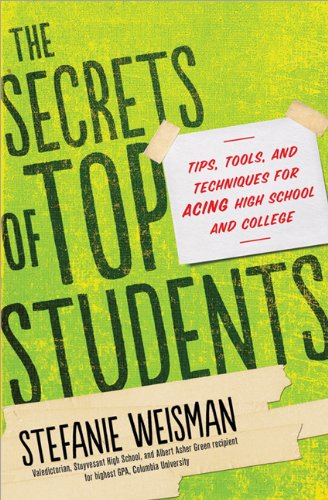
The Secrets of Top Students Back-To-School Giveaway

The Secrets of Top Students

The Secrets of Top Students

Hey all you students and parents out there!  Since it’s almost back-to-school time, I am giving away a copy of The Secrets of Top Students: Tips, Tools, and Techniques for Acing High School and College.  All you have to do is click here to enter.

Rules: NO PURCHASE NECESSARY. The 50th eligible entrant will win. This giveaway started Aug 14, 2015 10:16 AM PDT and ends the earlier of Aug 21, 2015 11:59 PM PDT or when the prize has been awarded.

Click here to enter giveaway.

About the book:

The Secrets of Top Students includes tips and techniques that every student should know. For example:

  • What is the first thing you should do when taking a math test?
  • What is an often overlooked place for coming up with a thesis?
  • What music should you listen to while studying?
  • Why is it bad to be a perfectionist?
  • What are the good and bad types of motivation?
  • What foods should you eat to boost your brainpower?
  • How much do top students really study?
  • Should you bring your laptop to class?
  • What are three game-changing learning techniques?
  • And much, much more.

Written in a conversational, down-to-earth manner, The Secrets of Top Students shows you how to maximize your learning and get the grades you want. Filled with innovative, time-saving techniques, this book also includes advice on motivation, the mind-body connection, and technology inside and outside the classroom.

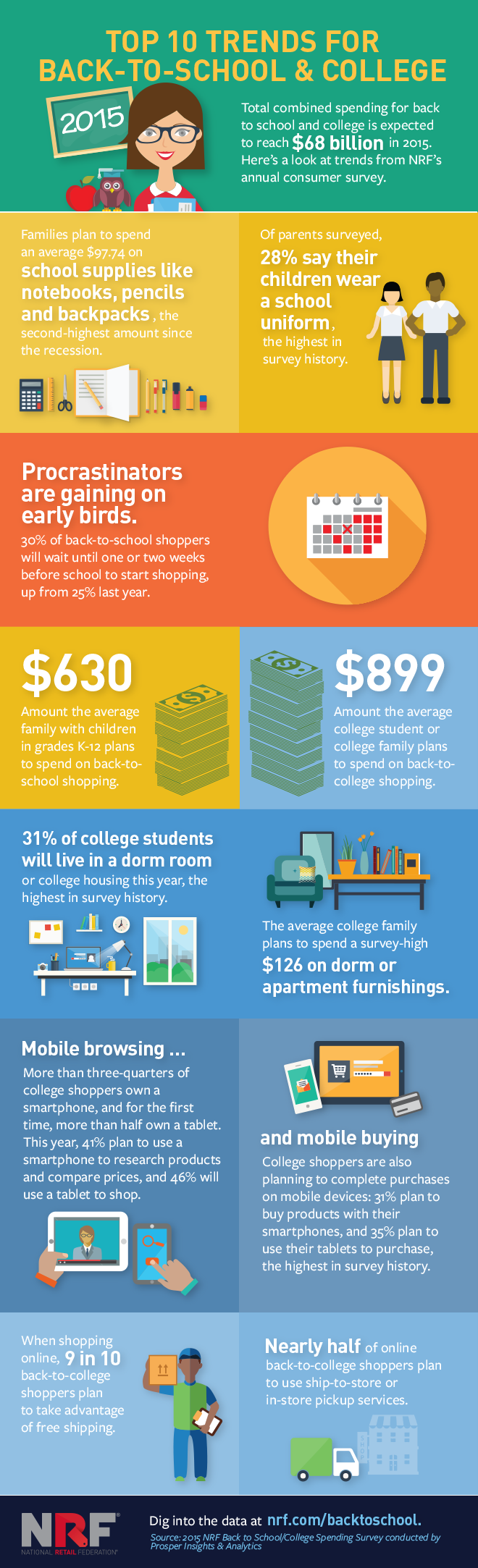
Infographic: Top 10 Trends for Back-To-School and College 2015

The summer is half over! Have you done your back-to-school shopping yet?

Top 10 trends for back-to-school and college 2015

Source: National Retail Federation


Don’t forget to order your copy of The Secrets of Top Students for the new school year!

A College Student’s Guide to Creatively Keeping in Touch

By Natalie Posdaljian

Keeping in touch as a college student is vital for maintaining relationships with family and friends, keeping them in the loop and weaving your home life with your college life. Reliable ways of keeping in touch, such as texts, emails and chatting on the phone, can get redundant and don’t always provide the best insight into your life as a college student. Instead, spice up how you keep in touch with your family back home.

student video chat

Video Chat

Video chatting with a laptop isn’t new to the scene nor is it the most creative way to keep in touch. Expand your virtual horizons with the iPad Air 2, which is thin and light enough to take anywhere. Video chat with your family at a public park in your new town or while you enjoy a much needed caffeine fix at your favorite coffee shop. Or, your family can video chat you when they all get together for a birthday party or Sunday afternoon BBQ. Although you won’t get a bite of the cake, you can still chat with all your aunts, uncles, cousins and grandparents.

Snail Mail

With the speed, efficiency and reliability of technology, it’s understandable why snail mail is a thing of the past. Yes, you have to handwrite your letter, buy a stamp, stop at the post office and wait a couple days for your mail to reach its destination, but that’s what makes snail mail fun. The feeling of checking the mailbox and finding something addressed to you that’s not a bill or advertisement is priceless. Sending snail mail to your family leaves them obliged to write you back, giving you something to look forward to in the mail. You also can throw in a copy of the A+ paper you wrote. Snail mail is especially great for grandparents, who typically appreciate handwritten letters the most.

Vlog

A vlog (video blog) is a unique way to show others what a day in the life of a college student looks like. Whether you keep it private for your family to enjoy or you make it a public YouTube channel, vlogging is in. Model one of your vlogs off a cooking show, with a twist on ramen or PB&J sandwiches. Vlog a tour of your favorite spots on campus, such as where you get your morning coffee, restaurants you frequent, the gym and the library. Or keep it simple and just talk straight to the camera about school, your roommates, professors and anything else that’s on your mind.

Shared Photos

There are so many ways you and your family can share your photos. If you’re looking to keeping it virtual, create a private album on Facebook and make all your family members contributors so everyone can swap photos. Or, use a photo sharing site like Flickr or Photobucket. Take it a step further by sharing developed photos (yes, people still develop photos). Throw just a few photos into that letter you’re sending, or use an app like Groovebook to upload all of your photos for just $2.99 (college budget approved) to send your family a keepsake photobook.

Family Facebook Group

A private family Facebook group is great for quick life updates, such as acing that Calculus exam, or for sharing links to YouTube videos with each other. Having your family in one Facebook group creates a forum full of sharing, likes and comments between the people that matter the most to you. For those statuses or photos you can’t share with your entire following, a private group lets you share your silly selfies or embarrassing stories with those that will love you no matter what.

Author Bio: Destined to be an Armenian housewife perfecting her hummus recipe, Natalie Posdaljian instead chose a life of marine field biology and sriracha. Born and raised in southern California, her veins rush with salty seawater and sunshine no matter where she goes.  When she’s not saving jellyfish from extinction, Natalie is dancing in the shower, knitting on a plane or swinging in her hammock.


Going to college?  Give yourself the gift of good grades with The Secrets of Top Students!

Is There a Right Way to Drink? A Healthy Perspective on College Drinking

By Adrienne Erin

Congratulations! You’ve finished high school. Now it’s time to head off to college. Isn’t it great to feel free? No parents and no boring home life. You’ll get to make new friends and have new experiences. And best of all, you’ll get to go to parties. What’s not to love?

It’s a given that you’re probably going to drink at least once in college. Chances are you’ve heard the pep talk about alcohol multiple times already, so you know what’s coming. But the point is: Sure, you can have fun, but it’s important to remember you’re in college to learn. Part of that learning is to gain a healthy perspective on drinking.

There’s a wrong and right way to drink. Which one will you choose?

The Wrong Way to Drink

This shouldn’t really need explanation, but people still abuse alcohol every day. Those who don’t drink responsibly can exhibit reckless behavior such as:

  • pressuring others to drink
  • binge drinking
  • drinking at a very fast pace
  • messing with other people’s drinks
  • driving drunk

If you think you see someone drinking irresponsibly, do your best to stay away from them. Find some new people to hang out with, or leave the party.

The Right Way to Drink

If you’re underage, it’s obviously wrong to drink in the first place. But if you do choose to drink at a party, keep these tips in mind:

Make a plan for how you will get home.

This should be the first thing you think about when preparing for a night out. Know how you’re getting home well before the party.

There are a few ways to go about this. You can have a designated driver within your friend group. If there’s public transportation in your area, like buses or trains, use them. NEVER get into a car with anyone who has had too much to drink, and NEVER drive drunk – even if you’re just tipsy. You’ll pay for the consequences of those poor decisions for the rest of your life.

Pace yourself.

It takes a little while for the effect of alcohol to kick in. You might feel completely fine right after taking a shot, but remember that you’ll start to feel the effect a few minutes after.

Make sure to space out your drinking. Having a non-alcoholic drink in between, such as soda or water, helps keep you from going too fast. Aim to keep a one-to-one ratio with one glass of water for each glass of alcohol. For each alcohol beverage you have, drink a non-alcoholic beverage.

Keep in mind that safe, responsible drinking means no more than one drink in an hour.

For reference, one drink equals one 1.5 oz. shot of 40% alcohol, one 5 oz. glass of wine or one 12 oz. beer per hour.

Drink with people you know.

It’s a wise choice to stick with your friends while drinking. If you go alone, you could get into trouble and have no one to look out for you. Avoid drinking with people you don’t know that well or don’t trust. These people could potentially be dangerous, or they might run off somewhere else without telling you.

It’s also important to stay with friends who drink in moderation. Stay away from people who oppose not drinking as much, or encourage binge drinking.

Keep an eye on your drink too, especially if you’re with people you don’t know well. They might seem friendly, but they could sneak date rape drugs or something else dangerous into your drink.

Eat something before or during drinking.

If you drink on an empty stomach, you’ll feel the effects of alcohol quicker. You might also feel sicker. Eating before you go out will help you stay under your drinking limit.

Be sure to eat a meal rich in proteins and carbs. These help to absorb the alcohol.

Know your limits, and measures.

You are the most important person at the party! Your friends may keep a close watch over you, but you also have to take care of yourself. Part of this is knowing your limits. Listen to your body – it won’t take much to figure out how much is enough.

If it’s your first time out, drink at a steady pace to determine your alcohol tolerance. It also helps to drink with friends or people you know well so that you won’t get socially anxious and drink more than you can handle.

You can quantify your tolerance, as well. For example, it could be “three beers per night,” or “two glasses of wine in four hours.”

If you want a fun, harmless way to help you determine what an effect certain amounts of drinking could have on your body type, try this choose your own adventure game.

Know how to turn down a drink.

Drinking is supposed to be a social activity, not a place to show off how much you can stomach. There’s no need to keep up or even accept a drink in the first place.

When you don’t want to drink, decline with a polite excuse. A simple “No, thank you,” should do the trick, but if needed, you can add more. Try things like “I don’t drink,” “I have to drive home,” “I’m the designated driver,” or “I’m pacing myself.”

Choosing Not to Drink is Totally Okay

If you don’t like drinking to begin with, it doesn’t make you uncool in the slightest. You should applaud yourself for steering clear of a night that could negatively impact your health or your life. In fact, there are tons of other alternatives to a night of partying.

You can always stay in and have a fun-filled night with your friends. Watch movies, play video or board games or see what’s going on around campus. Or, check out this list.

College campuses usually have great alternatives to parties on weekends. These can include things like dances, paint parties, movies, social gatherings, speed dating or athletic intramural events.

Whichever you choose, know that there’s a right and wrong way to drink. When you go out, plan ahead of time and be alert. You’ll thank yourself after a long night of partying – and if you do things right, maybe you won’t feel so groggy the morning after, either.

Top Tips to Keep Your Identity Safe During Your College Search

By Elliott

According to the Javelin Strategy and Research 2013 Identity Theft Report, individuals aged 20-29 account for one in five complaints of identity theft reported to the FTC, which is the largest number of complaints among any age group. At the same time, the number of identity theft complaints within this age group filed has increased from 56,635 complaints in 2010 to 57,491 in 2012 according to TribLIVE. These trends suggest hackers and identity thieves are taking more interest in young adults. One of the primary reasons is that college students who generally have good credit scores are much less likely to watch their financial accounts and credit scores.

To protect yourself from fraud, you need to understand identity theft and take all of the precautions to reduce your risk, especially while you are applying to schools and visiting campuses. Below are tips for protecting your identity and your financial future.

visiting college campus Continue reading

What Type of Learner Are You? How to Find Your Learning Style

Editor’s Note: The concept of learning styles is controversial.  The views expressed in this article are those of the author, and do not necessarily reflect the views of this website.

By Cindy Boesel

A clash of learning styles can be one of the biggest setbacks in the learning process. That’s why it is important to discover the learning style that suits you the most. People are different, and every one of us requires a different kind of support, special attention to certain things or some alone time to acquire maximum information. The sooner you discover your natural learning predispositions, the better chance you have to successfully change your learning techniques. Let’s take a closer look at different learning styles and methods to recognize your preferences.

Learning styles

We distinguish seven major learning styles. Keep on reading to find out how to differentiate between them.

What's your preferred learning style?

What’s your preferred learning style?

Continue reading