Eight Rules for Writing a Great Paper (Guest Post)

Lois Weldon is a professional writer at the dissertation writing service Uk.bestdissertation.com.  She is an ESL teacher.  Her hobbies are decoupage and writing poetry.  She loves Marvel comics and homeschooling her 7-year-old son.

If you’re a college student, you’ve probably completed hundreds of writing assignments and become intimately familiar with the writing process.  But writing does not stop with graduation – you’ll have plenty of opportunities to write even after you finish school. No matter how much writing you’ve done, it never hurts to learn a few tips and tricks to facilitate the writing process.
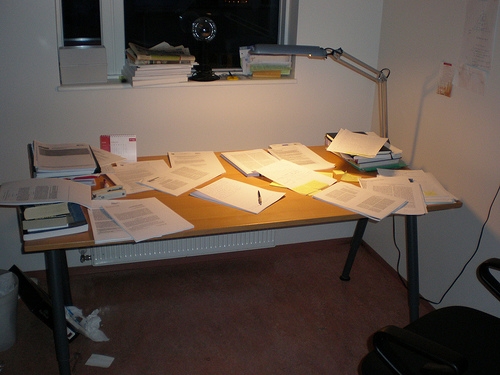
Read these tips before writing that paper.  Photo by gudmd.haralds via Flickr.

Does this look familiar to you? Read these tips before writing that paper! Photo by gudmd.haralds via Flickr.

  1. Make an outline. The importance of having an outline can never be overstated. An outline is a blueprint for your assignment. Developing an outline will help you organize your ideas, conduct better research, and estimate the word count for every section.
  2. Take note of the structure. When doing your writing assignment, make sure it has an introduction, a body and a conclusion. An introduction should introduce your topic and provide background information, while the body of the paper should contain the supporting evidence for your paper. Lastly, provide a conclusion by summarizing your argument and putting it in context. Remember: the conclusion is your last chance to impress your readers, so make it memorable!
  3. Ensure continuity of ideas. Imagine if your paper is all over the place – that is, you discuss a certain topic in one paragraph, then introduce an entirely unrelated topic in the next paragraph. Your reader will not be pleased. It’s important to maintain continuity so your readers will be able to follow your train of thought.
  4. Keep it objective. When it comes to academic writing, what really count are facts and relevant information. While your opinion does matter, refrain from incorporating it on your writing assignment. It is imperative that you present a clear and unbiased picture based on evidence and expert studies. Unless your opinion is being asked, don’t include it in the paper.
  5. Use bullets and numbering. In some academic writing, bullet points are preferable to long-winded paragraphs. This will allow you to discuss each point in an efficient and organized manner. Plus, it’s easier on the eyes.
  6. Take note of the word count. When writing your assignment, keep in mind that too few words means you won’t be able to express your ideas effectively, while too many words can lead to superfluity or duplication of ideas. If you are given a required word count, stick to it! In your outline, indicate how many words you should allot per section.
  7. Use examples. In a writing assignment, you must show that you understand the resources and materials you gathered from research. Use concrete examples to apply what you’ve learned and support your arguments.  You should also make use of tables, statistics and figures in your paper.
  8. Cite your sources. When it comes to academic writing, citing your sources, especially when you’re borrowing an idea or theory, is a must. Plagiarism is a form of stealing and you don’t want to compromise your future just because you did not acknowledge someone else’s work.

For more tips on how to write a paper and much more, order your copy of The Secrets of Top Students today!

Summer 2013 Update

A lot of my articles have been popping up on the internet recently, and I wanted to share some of them here.

1. What Motivates Top Students? Getting Into the Heads of High Achievers, HackCollege.
What I learned about academic success, from my own experience as well as from my survey of forty-five of the best students in the country.

2. Struggling to be heard: What it’s like to be a student who stutters, USA Today College.
An account of my struggle with stuttering in high school and college, how I overcame it, and what to do if you stutter or meet a person who stutters.

3. I Got the Highest GPA at an Ivy, But Not Because I’m Smarter Than Everyone Else, Your Teen for Parents.
Some surprising facts about top students and how they got that way.

My book, The Secrets of Top Students, has also received some great reviews lately. I was especially thrilled with this one from the School Library Journal: “…the book is a must-read for students in middle school and up, teachers, parents, and guidance counselors as 21st-century students learn to excel in the new educational landscape in which they find themselves.”

On a completely separate note, a funny article I wrote a few months ago, The Top 6 Reasons You Should Date a Pilot, has been Liked over 14,000 times on Facebook!

How Stuyvesant Influenced My Writing Career

On Sunday, June 23, I was honored to participate in the “Writer’s Block” event at the Stuyvesant High School all-class reunion, along with eight other writers who are Stuy alumni: Richard (R.B.) Bernstein, Robert Timberg, Joe Dorinson, Peter Wortsman, Eugene Schlanger, Rebecca Pawel, Richard Herschlag, and Becky Cooper. They asked us to talk about things like the road to publication and the impact Stuyvesant has had on our writing careers. I thought I would include the questions that were asked, along with a summary of my answers.

The Secrets of Top Students

The Secrets of Top Students

(1) Tell us a little bit about your work (most recent or favorite) and what inspired you to write the book? Include why you choose the genre you did.

I just came out with my first book, The Secrets of Top Students. It’s an advice book for high school and college students on how to succeed in school. I was inspired to write this book because I felt like I had so much to share with other students. I’ve been a top student all my life – I was valedictorian of Stuy, class of ’99. I graduated from Columbia with the highest GPA in my class. I also have experience in a wide range of subjects – I have a B.A. in History, an M.A. in Art History, and a B.S. in Computer Science. Over the years I developed lots of techniques that helped me excel in school, and it just felt natural for me to write this book and share those techniques.

(2) What is your writing practice?

I just write whenever I can. My mind is usually the clearest in the morning, so I’m most productive then. I usually write at home, but I write outside whenever I can. I’m a pretty slow writer. I write a few pages, and then I spend a lot of time editing. Some days I’m much more productive than others.

(3) Describe the road to publication, from idea to release.

This idea started when I was getting my last degree, a B.S. in Computer Science from Columbia. I started writing down all the techniques that I was using, and all the things that my classmates were doing wrong – things like cramming for tests, not taking enough notes, not managing their time well, not asking for clarification, etc. After I graduated I wrote the first three chapters, did a lot of research, and surveyed forty-five other top students to get their insight into what it takes to be a top student. These people are Rhodes scholars, Goldwater scholars, Fulbright recipients, students at top law and medical schools, and even a National Spelling Bee winner. A few months later I got an agent, Coleen O’Shea, and she helped me find a publisher/ get a book contract. It then took me a few more months to finish the book, which came out in May. The whole process, from idea to publication, took 4 or 5 years – but the idea was gestating for a long time.

(4) Describe how you went about finding an agent and how you went about finding a publisher or decided to self-publish?

I got a book called The Writer’s Market, which has a great listing of literary agents. I sent query letters to agents who accepted non-fiction books, and luckily I got one! She helped me work on my platform and create a book proposal. Then she submitted my proposal to a couple of publishers. I had phone interviews with a few of them, and Sourcebooks gave me a contract! I was really happy because Sourcebooks has a great education division. They publish books like The Fiske Guide to Colleges and Gruber’s Test Prep series.

(5) Was there a Stuyvesant Muse? Describe whether attending Stuyvesant High School had an impact on your writing endeavors.

I wouldn’t be here today without Stuyvesant. I learned how to be a great student here. Stuyvesant has such high standards, and the student body is so talented, that I had to develop powerful techniques to succeed. I’m sure many of you will agree with me that college was relatively easy compared to Stuyvesant. And of course, being valedictorian of Stuyvesant has a certain cachet that helped me get a book contract in the first place.

I’m not sure if I would use the term muse, but I was really inspired by Dr. Nikol, who taught AP European History. He was a great story-teller and made history come alive, as they say. I remember I did pretty poorly on the first few tests in his class because they were so detailed, and I had to readjust/ refine my study habits. He was one of the most demanding teachers I had here, but I learned so much. He was a big part of the reason why I specialized in medieval European History at Columbia. I still have a love of history, and that’s why I’m writing a historical fiction novel set on Crete during the time of the Minoans, which is currently a finalist in the James Jones First Novel Contest.

How to get rid of test anxiety

Do you do great on homework and essays, but freeze up on exams?  Do you have nightmares about the SAT?  Two recent articles in The New York Times and Time magazine address this common malady, and they have some interesting advice on how to bring your nerves under control.

Thinking about test anxiety.

Thinking about test anxiety.

Advice from the Time magazine article “Relax, It’s Only A Test,” by Annie Murphy Paul (Feb. 11, 2013)

1.  Engage in “expressive writing.”  Spend ten minutes before the exam writing about your thoughts and feelings.  This helps you cast off your anxiety and focus on the task at hand.

2.  Do a “values-affirmation exercise.”  Choose something that’s important to you – for example, music, family, religion, anything – and write about why it matters to you.  Research has found that minority and female students who did this improved their test-day performance.

3.  Write down positive statements, self-affirmations or mantras and keep them in a handy place.  The article describes how girls at the Laurel School in Ohio were given “special test-day pencil[s],” which were wrapped in pieces of paper that contained encouraging (and true) statements such as, “Girls get higher grades than boys.”

4.  Make sure you’ve prepared for the test the right way!  It may not be enough to read and re-read your notes and books – you should also take practice tests, ask yourself questions about the material, and try to predict what’s going to be on the exam.

5.  Do relaxation exercises, such as yoga.  The article describes how third-graders who were taught breathing and relaxation exercises showed a significant reduction in test anxiety.

Advice from The New York Times article, “Why Can Some Kids Handle Pressure While Others Fall Apart?” by Po Bronson and Ashley Merryman (Feb. 6, 2013)

This article’s a bit more scientific and complex.  Its basic premise is:

Understanding their propensity to become stressed and how to deal with it can help children compete. Stress turns out to be far more complicated than we’ve assumed, and far more under our control than we imagine. Unlike long-term stress, short-term stress can actually help people perform, and viewing it that way changes its effect. Even for those genetically predisposed to anxiety, the antidote isn’t necessarily less competition — it’s more competition. It just needs to be the right kind.

The article talks about the COMT gene, which has two variants: one that slowly removes dopamine from the brain, and another that clears it quickly.  People carry one variant or the other, or a combination of the two.  Studies have found that under normal conditions, those with the slow-acting variant have a cognitive advantage.  However, in stressful situations – e.g., test time – the people with the slower enzyme can’t remove dopamine fast enough, and those with the speedier kind take the lead.  They’re often the ones who do better on tests.

Some researchers have labeled those with the fast-acting enzyme “Warriors” and those with the slower variant “Worriers.”  One isn’t necessarily better than the other, it’s just that the Warriors may have an advantage in situations such as tests.  About half of us are a mix between Warrior and Worrier, while a quarter carry Warrior-only genes, and a quarter are Worrier-only.

So are we all predestined to be good or bad test takers, based on our genes?  Researchers say it’s not that simple.  People who are Worriers can significantly improve their performance if they are exposed to stress the right way and allowed to acclimate to it.  Based on their research, here are some more ways you can become a grade-A test-taker:

1.  Tell yourself that stress is beneficial.  It may sound weird, but it works!  Here’s an interesting tidbit from the article:

The first experiment was at Harvard University with undergraduates who were studying for the Graduate Record Examination. Before taking a practice test, the students read a short note explaining that the study’s purpose was to examine the effects of stress on cognition. Half of the students, however, were also given a statement declaring that recent research suggests “people who feel anxious during a test might actually do better.” Therefore, if the students felt anxious during the practice test, it said, “you shouldn’t feel concerned. . . simply remind yourself that your arousal could be helping you do well.”

Just reading this statement significantly improved students’ performance. They scored 50 points higher in the quantitative section (out of a possible 800) than the control group on the practice test. Remarkable as that seemed, it is relatively easy to get a result in a lab. Would it affect their actual G.R.E. results? A couple of months later, the students turned in their real G.R.E. scores. Jamieson calculated that the group taught to see anxiety as beneficial in the lab experiment scored 65 points higher than the controls. In ongoing work, Jamieson is replicating the experiment with remedial math students at a Midwestern community college: after they were told to think of stress as beneficial, their grades improved.

The study found that the students were still stressed, but that “it had different physiological manifestations and had somehow been transformed into a positive force that drove performance.”  The researcher also found that “the people told to feel positive about being anxious had their blood flow increase by an average of more than half a liter per minute, with more oxygen and energy coursing throughout the body and brain. Some had up to two liters per minute extra.”  Amazingly, hearing that stress is beneficial can improve your cognitive function!

2.  “Inoculate” yourself to stress by engaging in competitive activities you might actually enjoy, such as math competitions, trivia contests, spelling bees, science fairs, chess teams, etc.  Although these things can be stressful, they can also be fun and rewarding.  And getting used to competition will make it easier to take tests.

Good luck!


For more tips on studying and much more, order your copy of The Secrets of Top Students today!
Education News: Recommended Articles

From college rankings to kids sticking themselves with IVs to study longer, here are some education stories you might enjoy:

NPR story about How Children Succeed: Grit, Curiosity and the Hidden Power of Character, by Paul Tough. I love his name, by the way – very appropriate. This book sounds great and it speaks to all the things I’ve been saying recently. Academic achievement (and achievement in life) depends on hard work and perseverance, not talent and luck.

The College Rankings Racket, by Joe Nocera. Are college rankings really a racket? I think that’s going a little too far. Mr. Nocera’s article links to U.S. News‘s description of how they rank schools, and it sounds pretty legit to me. Sure, some kids place too much pressure on themselves to go to certain schools, but that doesn’t mean the rankings are pointless. What do you think?

Chinese students use IV amino acids to study for high-stakes tests, by Valerie Strauss. Apparently some high school students in China receive IV drips of amino acids so they can better prepare for the high-stakes college entrance exams. I feel sorry for these kids.

7 Questions to Ask Yourself When Choosing a Major. This is a great article for all you college students out there. The last question may be the most important: Is this what I want or what someone else wants?


Give yourself the gift of great grades.  Order your copy of The Secrets of Top Students today!

Will We Be Publishing Books Written in Digital English Someday? (Guest Post)

I’m excited to introduce my first guest blogger, Alexa Russell.  In this post, Alexa writes about nothing less than the future of the English language.  While we need to recognize the importance of Internet English, we should be wary of relying on it too much.  What’s your take on the issue?  Should we embrace the patois of the digital age, or fight to keep ‘proper’ English alive?  Should digital English become part of what you actually learn in English programs?  Without further ado, here’s Alexa.

The digital migration brings millions of new users to the Internet daily, with even more returning day after day to their favorite informational resource. Not only do these individuals access countless stores of knowledge held on websites and databases, they also contribute to the Internet by publishing in the form of Twitter and Facebook updates and blog posts. Many of these publication forms champion cursory writing, and in response many Internet users have found ways to express themselves through acronyms or shortened words.

This has spurred a huge debate about the current state of the English language. On the one hand, many believe that the rules of grammar serve as the best way to express yourself and be taken seriously. Others, however, believe that these rules hinder actual communication and force people to follow archaic rules that are inefficient for the digital age. The point of using abbreviations or removing vowels from words, after all, is to communicate more quickly.

A January 2012 feature article published by Wired Magazine illustrates why we should embrace this digital form of English. As the headline announces, “Its Tyme to Let Luce” with the rules of casual conversation. “English spelling is a terrible mess anyway,” writes Anne Trubek, “full of arbitrary contrivances and exceptions that outnumber rules. Why receipt but deceit? Water but daughter?”

Efforts to stem the digital corruption of English only get in the way, Trubek argues. Autocorrect software, which attempts to make sense out of misspelled words, both purposefully and not, often further complicates intended meanings by correcting to the wrong word.

Even colleges and universities, the bastions of proper English and, are beginning to embrace digital applications. A January 2012 piece published in the New York Times reports the attempts of Duke English professor Cathy Davidson to do away with the traditional term paper in favor of consistent posting to a class blog.

Although she finds that this outlet supports writers that rely on creativity in their prose, many feel that the rigid rules of proper grammar need to be respected, especially by college students. “Writing term papers is a dying art, but those who do write them have a dramatic leg up in terms of critical thinking, argumentation and the sort of expression required not only in college, but in the job market,” said Douglas Reeves, founder of the Leadership and Learning Center and a columnist for the American School Board Journal.

The youngest among us have incorporated digital forms of English so completely into our usage that it often finds its way into oral conversation. The Baltimore Sun published a May 2012 piece on different acronyms and abbreviations that parents should know in order to communicate with their children. Many of the more popular ones, like “YOLO” and “OOMF” are relatively new but are already being used by millions.

What the digital migration has allowed people to do is construct their own rules of conversation, apart from those held sacred by the old school of grammar. There’s no doubt that people will continue using these forms of speech, and postmodern writers have long been published advocates of English deconstruction. With the ease of publishing today, digital English will continue to take hold. However, those who don’t publish works that adhere to at least some standard rules of writing, may find that their audience dwindles when they can’t understand what they’re reading.


Give yourself the gift of great grades.  Order your copy of The Secrets of Top Students today!

What’s the point of a college education?

There have been a lot of articles questioning the value of a college education recently – particularly the value of a liberal arts education. Take, for example, Frank Bruni’s The Imperiled Promise of College and Michelle Singletary’s Not All College Majors Are Created Equal. These articles warn against choosing majors that tend to result in low-paying jobs (or no jobs at all). That’s why I was glad to read Alina Tugend’s article Vocation or Exploration? Pondering the Purpose of College, which argues that college students can and should study the humanities. As Ms. Tugend writes, the question is this: is the purpose of college to “ensure a good job after graduation,” or “to give students a broad and deep humanities education that teaches them how to think and write critically? Or can a college education do both?” I’m going with door number three.

In the article, Ms. Tugend notes that what students major in has a greater impact on their future earnings than in previous decades.

So does that mean I should urge our son to pursue a degree he doesn’t have any interest in because it may provide him with a higher-paying job — or any job, for that matter — after college?

No, Professor Carnevale said, because if you don’t like what you do, you won’t do it well. The point is that “young people now need to have a strategy,” he said. “If you major in art, realize you will have to get a master’s degree. The economic calculus has changed.”

I like that line – if you don’t like what you do, you won’t do it well.

When I was in college, my most rewarding classes were in the humanities. I specialized in medieval history and got an M.A. in Art History before I majored and got a job in Computer Science. Do I regret studying history and art history, where job options are extremely limited? Not in the least. I’m glad I have a background in the humanities – I think it makes me a more well-rounded, knowledgeable, appreciative person. (However, I’m lucky that I didn’t go into debt to get my degrees. If I did owe lots of money, perhaps I wouldn’t be so pro-liberal arts.) One of the best things about Columbia, my alma mater, is that it has a Core Curriculum. All undergrads, no matter what their major, are required to take classes like Literature Humanities and Contemporary Civilization, where they have literally hundreds of pages of reading each week on everything from Homer to Dante to Freud. This was probably the highlight of my academic career.

Lastly, I was quoted in a Crain’s New York Business article last week – Goodbye, ‘bamboo ceiling’ – Corporate barriers spur Asian-Americans to start fast-growing enterprises, by Emily Laermer.

When Stefanie Weisman was Stuyvesant’s valedictorian in 1999, she said, the school was about half Asian. She described her time there as ‘the most intense four years of my life’ because of its competitiveness.

‘The students there are bright and hardworking, partly because there are so many Asian-American students,” she said, citing the influence of ‘tiger parents.’ . . . .

It’s also possible that tiger parenting ultimately backfires. Ms. Weisman, who is writing a book about academic success, said that those who enjoy learning – rather than studying because their parents insist – tend to do better professionally.


Give yourself the gift of great grades.  Order your copy of The Secrets of Top Students today!

Want to increase the number of students in STEM? Try grade inflation

There’s been a lot of talk these days about how to get more students to study STEM (science/technology/engineering/math) in college. Of course, one of the problems is that the math/science education provided in many high schools is inadequate. But there are also lots of students with exceptional educational backgrounds who decide they just can’t hack it in STEM. See the article “Why Science Majors Change Their Minds (It’s Just So Darn Hard),” by Christopher Drew in The New York Times, from November 4, 2011.

Here’s my half-serious suggestion: use grade inflation. Elite students are used to getting straight-As and stellar SAT scores. Throw them into an environment where they’re suddenly getting Bs and Cs, and of course they’re going to freak out. The humanities have endured grade inflation and survived. Many teachers now use A+s to signal extraordinary achievement. Honestly, I don’t care if you raise grades in STEM or lower grades in the humanities, but there should be some kind of standardization. Why should STEM courses have completely different grading criteria? Teachers can do whatever they want; there’s almost no regulation. If an engineering student is struggling just to get a C and sees his roommate earning an easy A in anthropology, he’s not going to be happy.

Top universities also need to offer more practical STEM courses, not just theoretical. Students who can’t or don’t want to join academia are given short shrift. I had to take a continuing education web design course at NYU one summer because there was nothing like that offered at Columbia. The requirements for STEM majors should also be less restrictive. As a Computer Science major at Columbia, I couldn’t take a lot of CS courses that interested me because they didn’t fulfill the requirements for my concentration, and I didn’t have the time or money to pursue them. Instead I had to take a bunch of required theory courses that I detested and never got any use out of.

As a side note, Sesame Street is also getting in on the math/science craze. I’ll be interested to check back in 15 years and see if it made a difference.

I selected this post to be featured on www.educationblogs.net. Please visit the site and vote for my blog!

Give yourself the gift of great grades.  Order your copy of The Secrets of Top Students today!

How to Write a College Research Paper

I’m happy to announce that my first guest post for StudentAdvisor.com is now online! Click here to read The Five Rs of Writing a College Research Paper.
In case you’re wondering, the Five Rs are:

  • Read the instructions
  • Restrict your focus
  • Research actively
  • Reinforce your argument
  • Revise, Revise, Revise

Okay, so maybe that’s Seven Rs, but who’s counting? Read more here.

2/8/12 Update:
The Rise Scholarship Foundation has re-posted my article here!


For more tips on how to write a paper and much more, order your copy of The Secrets of Top Students today!