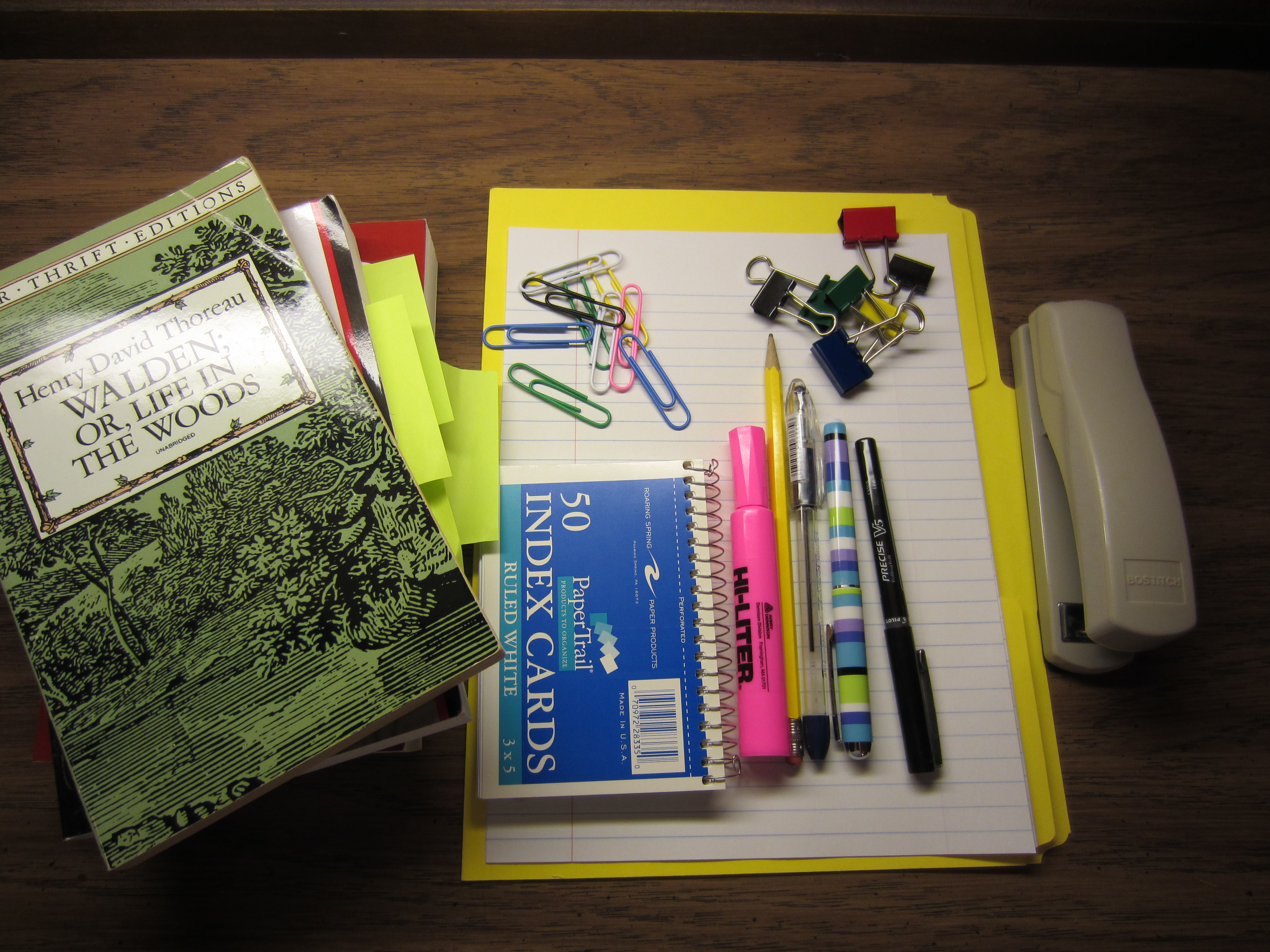
The Benefits of Going Low-Tech in College

Low-tech tools

USA Today‘s College Blog just posted my article on the benefits of going low-tech in college!  In it, I explain why ditching your laptop may be good for your GPA.  There were a bunch of things I didn’t get to include in the article, though, so here’s some more advice about how to avoid the pitfalls of technology in the classroom.

      1. How to use slides.In my article, I caution against relying too much on the professor’s PowerPoint presentations, which are now commonly posted online.  But that doesn’t mean you shouldn’t use them at all – they can make taking notes easier and faster, if you use them the right way.  Here’s one way to do it:
        • If the slides are posted before class, print them out and number each one.  Bring the print-outs and a notebook to class.  Write today’s date on your slides and in your notebook.
        • Take notes directly on the slide printouts as they are covered in class.  Flesh out the slide’s outlines with details and examples provided by the professor.
        • If you run out of space on a slide printout, write that slide’s number in your notebook and continue taking notes there.  That way, when you’re reviewing, you can easily match up the slide with the relevant section in your notebook.
        • If the slides are posted after class, take notes as you normally would and use the slides as a supplement.

The benefits of paper

    1. When in doubt, print it out. Many professors have joined the environmental movement by posting syllabi and assignments online instead of printing them out.  This is all well and good for Mother Earth, but it may not be the best thing for your GPA.  If you don’t print out important documents, there’s a much greater chance that you will overlook some key detail.  I observed this numerous times in my paper-free classes.  For example, when essay assignments were posted online, many of my classmates were unaware of essentials such as the due-date and topic.  During finals, they often lost points because they hadn’t noticed certain required readings on the online syllabus.  During meetings for group projects, I was often the only one who could clarify the requirements because I had the assignment right there in front of me.  Printing out documents saves you from having to turn on your computer and navigate to your course’s web page every time you want to check something. If your conscience nags you about killing trees, remind it that you can recycle the paper when the term is over.
    2. Books aren’t dead yet. Dr. Jakob Nielsen, a web usability expert, has some alarming things to say about how technology affects reading comprehension.  “The online medium lends itself to a more superficial processing of information,” he says. “You’re just surfing the information. It’s not a deep learning.” Although reading speeds on electronic devices have improved, they’re still not as good as reading on paper: in Mr. Nielsen’s study, the iPad measured at 6.2% lower reading speed than the printed book, whereas the Kindle measured at 10.7% slower than print. And if you’re even thinking about doing serious reading on your iPhone, I have one word for you: don’t. Reading comprehension scores are 48% of the desktop level when using the iPhone-sized screen. That is, it’s twice as hard to understand complex content when reading on an iPhone versus on a full-sized computer screen.
    3. Be more independent. Lastly, this week’s Time magazine provides more evidence that we’re becoming overly dependent on technology and losing our ability to contextualize information. According to Annie Murphy Paul in the article “Your Head Is in the Cloud”

      Research conducted by Betsy Sparrow, an assistant professor of psychology at Columbia University, and published last year in the journal Science has identified three new realities about how we process information in the Internet age. First, her experiments showed that when we don’t know the answer to a question, we now think about where we can find the nearest Web connection instead of the subject of the question itself. . . . A second revelation: when we expect to be able to find information again later on, we don’t remember it as well as when we think it might become unavailable. . . . The researchers’ final observation: the expectation that we’ll be able to locate information down the line leads us to form a memory not of the fact itself but of where we’ll be able to find it.”

      Scary stuff. You can’t have an intelligent conversation if you have to look something up on your computer every 20 seconds. We must use technology with restraint, both in school and in our post-graduate lives.


Give yourself the gift of great grades.  Order your copy of The Secrets of Top Students today!

Introverts Unite!

I love the article “The Upside of Being an Introvert (And Why Extroverts Are Overrated)” by Bryan Walsh in Time magazine. I’m glad that people are finally starting to give introverts their due. I am an introvert to the extreme – I got the highest possible score for introversion on the Myers-Briggs personality test. Ten times out of ten, I would rather stay home with a good book than go to a party. That’s not to say that I’m a social outcast or don’t know how to behave around people. I just find it hard to be around large groups of people for long periods of time. I can force myself, but it’s not pleasant. I suspect that there’s a connection between introversion and academic performance. Introverts like solitude, and solitude leads to mastery of skills. As Mr. Walsh writes:

Florida State University psychologist K. Anders Ericsson believes that deliberate practice — training conducted in solitude, with no partner or teammate — is key to achieving transcendent skill, whether in a sport, in a vocation or with a musical instrument. In one study, Ericsson and some of his colleagues asked professors at the Music Academy in Berlin to divide violinists into three groups, ranging from those who would likely go on to professional careers to those who would become teachers instead of performers. The researchers asked the violinists to keep diaries and found that all three groups spent about the same amount of time — more than 50 hours a week — on musical activities. But the two groups whose skill levels made them likelier to play well enough to perform publicly spent most of their time practicing in solitude.

Unfortunately it’s getting harder and harder to escape the distractions of group work. This is true in school and even more so in the workplace. I hope that writers like Mr. Walsh and Malcolm Gladwell (who wrote about a similar subject in Outliers) will convince people of the power of being alone.


Give yourself the gift of great grades.  Order your copy of The Secrets of Top Students today!

Education Update

1) There’s an interesting article about the 10 most educated countries in the world. The U.S. did better than I expected. China isn’t on this list, which is evidently a sign that even though privileged Chinese students have been beating American students in science and math, the country as a whole has a long way to go.

Here are the top 10, with postsecondary education rates:
1. Canada
Pct. population with postsecondary education: 50%

2. Israel
Pct. population with postsecondary education: 45%

3. Japan
Pct. population with postsecondary education: 44%

4. United States
Pct. population with postsecondary education: 41%

5. New Zealand
Pct. population with postsecondary education: 40%

6. South Korea
Pct. population with postsecondary education: 39%

7. Norway
Pct. population with postsecondary education: 37%

8. United Kingdom
Pct. population with postsecondary education: 37%

9. Australia
Pct. population with postsecondary education: 37%

10. Finland
Pct. population with postsecondary education: 37%

2) Technology in the classroom.
There’s a good infographic about how professors are using social media:
Key stat: 80% of faculty use social media for some aspect of a course they are teaching.
Reading professors like an open facebook, or how teachers use social media
Courtesy of: Schools.com
And here’s an infographic on how 100% of colleges and universities are using it:
Pros and Cons of Social Media in Education

On a related note, Education Secretary Arne Duncan and Federal Communications Commission Chairman Julius Genachowski have been promoting digital textbooks. I’m not about to join the debate on this divisive issue, but here are some thought-provoking articles:
The Promise of Education Technology (It’s Not Just About Lighter Backpacks), by Joel Klein
Who really benefits from putting high-tech gadgets in classrooms?, by Michael Hiltzik


Give yourself the gift of great grades.  Order your copy of The Secrets of Top Students today!

The LD Advantage

Check out my article posted by the Rise Scholarship Foundation. Did I become valedictorian in spite of or because of a learning disability?

2/2/12 Update:
My LD article has been retweeted by Scorebusters!
Scorebusters Twitter page


Give yourself the gift of great grades.  Order your copy of The Secrets of Top Students today!

Want to increase the number of students in STEM? Try grade inflation

There’s been a lot of talk these days about how to get more students to study STEM (science/technology/engineering/math) in college. Of course, one of the problems is that the math/science education provided in many high schools is inadequate. But there are also lots of students with exceptional educational backgrounds who decide they just can’t hack it in STEM. See the article “Why Science Majors Change Their Minds (It’s Just So Darn Hard),” by Christopher Drew in The New York Times, from November 4, 2011.

Here’s my half-serious suggestion: use grade inflation. Elite students are used to getting straight-As and stellar SAT scores. Throw them into an environment where they’re suddenly getting Bs and Cs, and of course they’re going to freak out. The humanities have endured grade inflation and survived. Many teachers now use A+s to signal extraordinary achievement. Honestly, I don’t care if you raise grades in STEM or lower grades in the humanities, but there should be some kind of standardization. Why should STEM courses have completely different grading criteria? Teachers can do whatever they want; there’s almost no regulation. If an engineering student is struggling just to get a C and sees his roommate earning an easy A in anthropology, he’s not going to be happy.

Top universities also need to offer more practical STEM courses, not just theoretical. Students who can’t or don’t want to join academia are given short shrift. I had to take a continuing education web design course at NYU one summer because there was nothing like that offered at Columbia. The requirements for STEM majors should also be less restrictive. As a Computer Science major at Columbia, I couldn’t take a lot of CS courses that interested me because they didn’t fulfill the requirements for my concentration, and I didn’t have the time or money to pursue them. Instead I had to take a bunch of required theory courses that I detested and never got any use out of.

As a side note, Sesame Street is also getting in on the math/science craze. I’ll be interested to check back in 15 years and see if it made a difference.

I selected this post to be featured on www.educationblogs.net. Please visit the site and vote for my blog!

Give yourself the gift of great grades.  Order your copy of The Secrets of Top Students today!

How to Write a College Research Paper

I’m happy to announce that my first guest post for StudentAdvisor.com is now online! Click here to read The Five Rs of Writing a College Research Paper.
In case you’re wondering, the Five Rs are:

  • Read the instructions
  • Restrict your focus
  • Research actively
  • Reinforce your argument
  • Revise, Revise, Revise

Okay, so maybe that’s Seven Rs, but who’s counting? Read more here.

2/8/12 Update:
The Rise Scholarship Foundation has re-posted my article here!


For more tips on how to write a paper and much more, order your copy of The Secrets of Top Students today!

Re: Not all college majors are created equal

I just posted this on The Washington Post‘s website, in response to the article “Not all college majors are created equal,” by Michelle Singletary. The original article is here.

Sometimes, getting a good education and pursuing what you love are worth more than the immediate economic benefits of an in-demand major. Should you really go into engineering and hate what you do for the rest of your life? Yes, more people should consider going to state schools so they can take on less debt, but you know what, this recession isn’t going to last forever. There will be a time when there will be more jobs out there and English majors and maybe even architects will be able to support themselves. The author wants students to know what they want to do after they graduate. That seems like wishful thinking to me. Can most people really carve their career paths in stone when they’re 18 years old? I can’t even do it now, when I’m… well, never mind. If you do what the author wants, you’ll just have more people starting out in STEM (science/ technology/ engineering/ math) majors, finding out they don’t like it, and switching majors – perhaps even delaying their graduation and costing them more money – or sticking with it and quitting their unfulfilling STEM-related jobs in a couple of years. (See stats here)


Give yourself the gift of great grades.  Order your copy of The Secrets of Top Students today!

Re: Rating Stuyvesant High School

There’s an interesting take on my alma mater, from the students’ point of view. Not surprisingly, fastidious Stuy students are way harder on their school than the NYC Department of Education, which gave the school an A. See the article Rating Stuyvesant High School.

The Stuyvesant Spectator editorial board gave the following grades to their school:

Mathematics B-
Biology B
Chemistry B+
Physics C+
English A-
Social Studies B+
World Languages B-
Computer Science A-
Technology B
Music & Fine Arts B
Student Services B/B-
Facilities B+
Quality of Student Life B-

For a math/science school, the humanities are rated quite highly at Stuyvesant. I always thought that AP European History was one of the best classes I’d ever taken. By the way, if a Stuy student got this kind of report card, he/she would be in tears.

I especially like this part about quality of student life:

“For students who can manage their homework and studies, Stuyvesant offers a wide range of extracurriculars that can satisfy nearly every student’s interests. However, for what seems to be the majority of students, extracurriculars can seem like an extra burden piled upon heaps of coursework and mountains of textbooks. The atmosphere of constant competition with both other students and one’s own personal standards is highly stressful and can encourage massive sleep deprivation for those who are inept at prioritization and time management.”

You know what, I’m glad I’m not in high school anymore.


Give yourself the gift of great grades.  Order your copy of The Secrets of Top Students today!

More on STEM

I like this information sheet from onlineengineeringdegree.com.  As a former Computer Science student, I have some major unresolved issues with STEM (science/technology/engineering/math) courses.  I found that my program catered to people who already had a strong foundation in technology – i.e., not me.  Most of the professors were unfriendly or at least uncaring about how the undergraduates in their class were doing.  I had one professor who said that he wanted 10% of the class to drop out by the end of the semester – to this day, I don’t know if he was joking (and if he was joking, it wasn’t very funny).  The CS program I was in trained people for academic jobs and very advanced commercial jobs, but I felt completely unprepared for regular technical job interviews.  I also didn’t like that some STEM classes were graded so much harder than others – in some classes the average was a B or even a C – and so really don’t look good on your transcript.  In one class the average midterm grade was in the 40s, and we didn’t know how it was going to be curved till we got our report cards – scary!  I think part of the problem is that I am naturally a liberal arts person and not a math/science person, but STEM classes in general are not very welcoming.
STEM Shortage
Created by: Online Engineering Degree


Give yourself the gift of great grades.  Order your copy of The Secrets of Top Students today!

Are we raising a generation of Philistines?

That’s what I thought when I studied computer science. My classmates had trouble understanding basic written instructions. They were outraged when they had to read articles that were more than 10 years old. Most of them looked down their noses at liberal arts majors. Half of my professors didn’t know the difference between “it’s” and “its.” You would think they could at least have done a spell check.

According to Alexander Astin in What Matters in College, engineering majors actually suffer a decline in things like writing ability, cultural awareness, and political participation. I know that STEM classes are becoming privileged in this society, but I fear a world dominated by technocrats.


Give yourself the gift of great grades.  Order your copy of The Secrets of Top Students today!