Get Into These 4 Healthy Habits as You Head off to College

By K.C. Dermody

For most college students, going off to school brings the first real sense of independence and freedom. You’ll experience an abundance of unfamiliarity as you’re exposed to a new learning environment and living arrangements filled with different types of people. With this new environment and people comes a host of germs and viruses that can easily be passed around, potentially keeping you from your studies and threatening to impact your grades. In fact, 68 percent of college students stated that they missed class due to illness, according to a survey conducted on behalf of global hygiene company SCA.

You’ll probably make every effort to look your best by taking frequent showers and wearing the latest fashions, but there are many aspects of hygiene that college students commonly overlook. Ensure you’re taking the proper steps for good health this semester with these four tips:

1. Wash your hands often

Mom probably reminded you every single day to wash your hands, but now that you’re out on your own, it’s easy to forget. Good hand hygiene habits are crucial for preventing the spread of cold and flu viruses. The Center for Disease Control and Prevention offers these startling facts about hand washing:

  • It is estimated that washing hands with soap and water could reduce diarrheal disease-associated deaths by up to 50 percent.
  • More than 50 percent of healthy people have Staphylococcus aureus living in or on their nasal passages, throats, hair, or skin.
  • Hand washing can reduce the risk of respiratory infections by 16 percent.

Germs are commonly passed along when shaking someone’s hand, touching a stair railing or door knob, and handling money among many other common activities. Protect yourself by washing your hands with warm water and soap for at least 20 to 30 seconds.

washing hands

2. Take care of your contact lenses

If you wear contact lenses, you should know that they carry a risk of eye infection, particularly if good hygiene practices aren’t followed. Be sure to carefully follow the lens care guidelines your optician or ophthalmologist prescribed, and replace contact lenses frequently in order to reduce the risk of infection. Save money by ordering them online from a company like VisionDirect.

3. Maintain good oral health

Taking good care of your mouth and teeth helps to ensure that you have a healthy, attractive smile in addition to eliminating bacteria that can cause bad breath, cavities, and gum disease. Brush at least twice a day, and replace your toothbrush every three to four months. If you notice the bristles becoming frayed, it’s time to get a new one. Proper daily flossing is also a must. Floss one tooth at a time by sliding the floss in the space between your tooth and gum, gently rubbing the side of the tooth in and up and down motion.

4. Launder bed linens frequently

Laundry may be inconvenient with your new packed schedule and your living accommodations, but make every effort to wash your pillow cases, comforters and sheets in hot water and detergent at least once a week. Dust mites are drawn to the dark, moist environment of a mattress, and mite infestations are known to cause allergies and rashes as well as exacerbating asthma, according to the Asthma and Allergy Foundation of America.


About the author: K.C. Dermody is a freelance writer who has published work on numerous sites and in printed publications, including Yahoo Travel, Sports & News, RunLiveLearn and The Sherpa Report.


Going to college?  Give yourself the gift of good grades with The Secrets of Top Students!


How to Develop Good Reading Skills in the Internet Age

By Samantha Levine. 

It’s no laughing matter how dependent our society is on the use of technology and the Internet. The great thing about it is that we are exposed to so much information, but this can also be very overwhelming. As we learn to read from screen to screen (laptop, cell phone, tablet), we have readjusted the way we receive information, which is causing our attention span to be much shorter.

When skimming through an article, you may not realize how much information you can actually miss. A great tip to increase retention is to read the headlines of a topic and ask questions about what you think it will be about. While reading, see if you are able to answer your own questions, and then make note of it. This helps you to read quickly, efficiently, and effectively.

man on iphone

Can you read on this tiny little screen?

I’ve noticed that the faster I receive information from the web, the faster I move on to read something else; and more often than not, I’m distracted by an ad to the right and left of the story I’m reading. However, thanks to my very awesome grade school teachers who taught me to love reading, I learned a few tips that can keep you on track:

Continue reading

Last Day to Get The Secrets of Top Students for $2.99

Today is your last chance to get The Secrets of Top Students ebook for only $2.99!

This book includes tips and techniques that every student should know. For example:

  • What is the first thing you should do when taking a math test?
  • What is an often overlooked place for coming up with a thesis?
  • What music should you listen to while studying?
  • Why is it bad to be a perfectionist?
  • What are the good and bad types of motivation?
  • What foods should you eat to boost your brainpower?
  • How much do top students really study?
  • Should you bring your laptop to class?
  • What are three game-changing learning techniques?
  • And much, much more.
The Secrets of Top Students: Special Sale!

The Secrets of Top Students: Special Sale!

Here’s what people have been saying about the book:

Praise for The Secrets of Top Students

“An insightful guide for high achievers—and those aspiring to such status—from an authoritative source, Stefanie Weisman, a Columbia University graduate and former valedictorian of Stuyvesant High School, two of the best schools in America. Stefanie Weisman’s book about the secrets of academic success is all the more amazing, given the learning disabilities that she overcame to become the ultimate academic overachiever. As a graduate of Stuyvesant High School myself, as well as a Phi Beta Kappa graduate of Brown University, I believe students can find happiness and achieve great things at any number of schools, and Stefanie Weisman offers hard-fought wisdom about how to get there.”
Alec Klein, Northwestern University professor, bestselling author and award-winning journalist

“Although the target audience is high school and college students, the book is a must-read for students in middle school and up, teachers, parents, and guidance counselors as 21st-century students learn to excel in the new educational landscape in which they find themselves.”
Tammy Turner, Centennial High School, Frisco, TX; School Library Journal, July 2013 issue

“We wish we had Stefanie Weisman’s new book . . . when we were in school, but our loss is your child’s gain as this book goes beyond advising how to test better; it’s loaded with strategies on how to get the most out of school in a healthy, well-rounded way that will continue to serve your scholar well throughout their life.”
Lisa J. Curtis, Brooklyn Family Magazine, August 2013 issue

“A student who followed even half of the suggestions in this book could come away from college with both a greater understanding of the material and a significantly higher G.P.A.”
Dr. Mindy Marks, Associate Professor of Economics at Washington University, St. Louis, and Co-Author of “Leisure College, USA: The Decline in Student Study Time”

“This is perhaps the best and most pragmatic guide to academic success I have read that is relevant to today’s students. One thing that sets this book apart is that it provides special information for students interested in science, technology, engineering and mathematics, aka STEM subjects.”
Stuart Nachbar, President of Educated Quest, www.EducatedQuest.com

“Undergraduates who want to excel in college will find a helpful resource in this book.”
Joseph Adegboyega-Edun, Counselor/College Adviser, Walter Johnson High School, Bethesda (MD)

Secrets of Top Students Kindle Sale Update

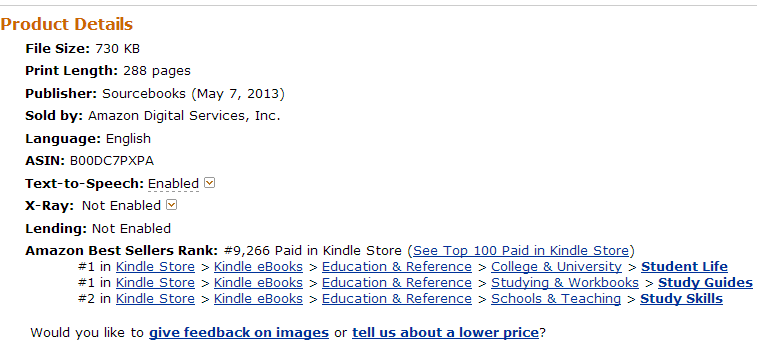
The Secrets of Top Students Kindle edition is currently the number 1 book in the Student Life and Study Guides categories on Amazon, and number 2 in Study Skills! Thank you for making this sale a success. Remember that you can still get your copy for $2.99 until May 11th!

The Secrets of Top Students on Amazon

The Secrets of Top Students on Amazon

The Secrets of Top Students Special Offer

For a limited time, you can buy the Kindle edition of The Secrets of Top Students for $2.99! Act now – this offer won’t last long. Give yourself – or your kids – the gift of great grades in high school and college.

The Secrets of Top Students: Special Sale!

The Secrets of Top Students: Special Sale!

Here’s what people have been saying about the book:

Praise for The Secrets of Top Students

“An insightful guide for high achievers—and those aspiring to such status—from an authoritative source, Stefanie Weisman, a Columbia University graduate and former valedictorian of Stuyvesant High School, two of the best schools in America. Stefanie Weisman’s book about the secrets of academic success is all the more amazing, given the learning disabilities that she overcame to become the ultimate academic overachiever. As a graduate of Stuyvesant High School myself, as well as a Phi Beta Kappa graduate of Brown University, I believe students can find happiness and achieve great things at any number of schools, and Stefanie Weisman offers hard-fought wisdom about how to get there.”
Alec Klein, Northwestern University professor, bestselling author and award-winning journalist

“Although the target audience is high school and college students, the book is a must-read for students in middle school and up, teachers, parents, and guidance counselors as 21st-century students learn to excel in the new educational landscape in which they find themselves.”
Tammy Turner, Centennial High School, Frisco, TX; School Library Journal, July 2013 issue

“We wish we had Stefanie Weisman’s new book . . . when we were in school, but our loss is your child’s gain as this book goes beyond advising how to test better; it’s loaded with strategies on how to get the most out of school in a healthy, well-rounded way that will continue to serve your scholar well throughout their life.”
Lisa J. Curtis, Brooklyn Family Magazine, August 2013 issue

“A student who followed even half of the suggestions in this book could come away from college with both a greater understanding of the material and a significantly higher G.P.A.”
Dr. Mindy Marks, Associate Professor of Economics at Washington University, St. Louis, and Co-Author of “Leisure College, USA: The Decline in Student Study Time”

“This is perhaps the best and most pragmatic guide to academic success I have read that is relevant to today’s students. One thing that sets this book apart is that it provides special information for students interested in science, technology, engineering and mathematics, aka STEM subjects.”
Stuart Nachbar, President of Educated Quest, www.EducatedQuest.com

“Undergraduates who want to excel in college will find a helpful resource in this book.”
Joseph Adegboyega-Edun, Counselor/College Adviser, Walter Johnson High School, Bethesda (MD)

The Top 4 Ways To Work On Your Career While Still In School (Guest Post)

By Alex Pejak.
Alex is an economist currently working on a few projects in Australia. She is passionate about market research and career development. She is also interested in topics related to project management and business IT.

As you study it’s always an excellent idea to keep the next step in mind. What will you do once you graduate? If you’re like most students, you’re planning to find a job and start a career. Yet we live in a very competitive economy and many students are finding that careers do not simply appear out of thin air upon graduation. The best jobs go to those who began preparing long before it came time to find one. To make sure you land the kind of position you’re hoping to get, it’s a good idea to start working on your career now, while you’re still in school.

In general, the most important and most effective ways of setting yourself up for post-graduation success involve building up your skills and experience in the field you’d like to work in. This gives you confidence in your choice of career, and shows employers that you’re ready. Also, the experience you gain during your studies will ensure you know the industry’s leaders, language, and trends, which will help you choose the best employer for you rather than finding yourself looking for the one with the largest career-fair booth.

1. Do The Best Job You Can  

The simplest method of setting yourself up for a smooth transition to the working world is simply putting in the effort during school. By being diligent, getting good grades, and participating both on and off campus, you start attracting fans and building up a network… people who will be eager to help you succeed later.

Sometimes, you may even find the organizations you volunteered at will want to hire you right out of school. Compared with sending out hundreds of CVs and sitting through dozens of interviews, this can be a highly appealing proposition.

In other cases, you’ll find your experiences mean that club leaders, peers, and professors will give you glowing references, and will help to mentor you as part of their own legacy. The resulting experiences will make for wonderful stories in job interviews, and your accomplishments will look excellent on your CV and in cover letters.

2. Intern or Volunteer In Your Time Off         

Often, the classic “student jobs” like bartending or retail have no connection to the career you want to pursue later. There are few better ways to explore an interesting-sounding career, on the other hand, than interning or volunteering in a related position. Make a point of spending your summers and breaks in positions, even if they’re unpaid, which have a connection to the career you want to pursue.

Since applying to internships is nearly identical to applying for a regular job — you’ll require a good quality CV and cover letter, and you may need to show language or computer certificates — the process will also provide valuable practice for the working world later.

3. Go Abroad    

Interning or volunteering abroad is a little more complicated, to be sure. However, expanding your horizons and learning to work in a different culture is always a valuable personal development experience and highly attractive to employers. Showing experience abroad on your CV will convey to potential employers that you can work well in nearly any situation, that you’re more well-rounded and balanced than most other candidates. This marks you as a candidate for leadership and management from day one.

Better still, going abroad is not as difficult as it sounds. While you will likely require translated copies of your CV, cover letter, references, certificates, and such, online translation makes this fast and easy. Additionally, once you’ve found a position in a foreign country, the firm will likely have resources to help you arrange a visa, accommodation, and the like.

4. Pick Your Classes Wisely   

Last but not least, though it may seem obvious to some, your choice of classes is an excellent way to work on your career as you study. You can use your classes as a way of learning about the current trends, major players, and language of the fields that interest you. Look at which classes have a practical application to your field of choice, and focus on those. Particularly in business classes, the materials you read may be the same things that shaped the management ideals of the companies you will go work for.

Conclusion

In many respects, the best ways of preparing yourself for a future career as you study are the simplest: put in as much work as you can, take every chance you get to gain hands-on experience in the field. The exception, studying or working abroad, is a little more involved but also one of the most rewarding. In fact, there’s a good argument to be made that going abroad is so beneficial because there are hurdles involved — most candidates you’ll be competing against won’t bother. Keep this principle in mind as you study, too. By looking for opportunities that most people can’t be bothered to take, it’s easy to give yourself a big advantage.

The first step to getting a good career is getting good grades in school.  The Secrets of Top Students can show you how!

Deciding to Become a Teacher (Guest Post)

By Fiona Mayberry.  Fiona loves teaching others, and loves that the internet allows her to reach different people every week. She currently writes about education policies and degree certification processes.

If you’re in high school or college right now, you’re probably putting a lot of thought into what you want to do with your life. It’s possible that the most influential people in your life have been teachers, which might inspire you to become a teacher yourself. Before you commit to that career path though, there are a few things to consider:

Source of Motivation

If you want to become a teacher to change people’s lives, that’s wonderful. Just know that you won’t feel like you’re making an impact every day. If you’re inspired by seeing small improvements in a student’s work, or knowing you made someone’s day better, then you’ll be fine. If, however, you expect to see large results quickly, you might go through long periods of time where you feel frustrated. It’s important to know yourself and have realistic expectations.

Hours

Some people are attracted to the teaching profession because they like the idea of working the same schedule every day. 7-3 Monday through Friday seems pretty cushy, and the idea of summer breaks is appealing as well. But teachers often have to take their work home to grade papers and create lesson plans. They also have after-school events such as staff meetings, parent conferences, and continual learning opportunities. You’ll work a lot more than just classroom hours. Also, depending on your financial situation, you might have to teach summer courses or find an additional source of income for vacation times. Keep all this in mind and know that class times are not going to be your only work times.

Do you have what it takes to be a teacher?

Do you have what it takes to be a teacher?

State Requirements

Every state has its own requirements for teaching certifications.  If you’re planning on moving, make sure you know the requirements for the state you’re considering. Certain areas require different tests and even prerequisite degrees and courses in order to take the certification tests. Classroom experience is also a qualification that varies state-to-state.

Likewise, states all have different laws when it comes to what is taught in the classroom. Look into how much input teachers in your target area have over what they teach. Look at the current proposed bills affecting education so that you know not only the current classroom atmosphere, but what it’s likely to be like in the future.

Once you take all these things into consideration, you will be more prepared to make an informed decision. Will a classroom environment allow you to thrive? Is teaching the way for you to fulfill your life goals? If so, start looking at online teacher communities, and talk with those in the field. The more you see of what teaching is actually like, the more prepared you will be to have a positive impact on student lives.


Want to improve your GPA?  Order a copy of The Secrets of Top Students today!

Building Healthy Lifestyle Habits in College (Guest Post)

By Dorothy Richardson
Parent, wellness coach, DIY guru

The college experience is formative not just in terms of education, but also in terms of lifestyle. As students move away from their childhood homes for the first time, they have complete control over every facet of their day. What they eat, when they sleep, how much they party, when (or if) they do their homework is all up to them. While this can be a great learning experience for young adults, it also presents potential downfalls if poor lifestyle habits are adopted. Those habits can carry on into adulthood and have negative effects on short and long-term health. With that in mind, college students should make a concerted effort to build healthy lifestyle habits while still in school. Here are four ways to preserve physical and mental health, both now and in the future.

Healthy Lifestyle Seamless Pattern

Establish a Regular Sleep Routine

A regular sleep schedule has numerous positive effects on a college student’s health. According to Scholarships.com, students who get 7 to 9 hours of sleep on a regular basis experience improved concentration and reduced fatigue. Those students may also experience a reduced appetite, which can help combat college weight gain. As the Centers for Disease Control and Prevention note, the ill-effects of poor sleep can be severe; teenagers and young adults may suffer from poor academic performances, depression and increased social difficulties.

Unchain Yourself and Get Active

College students can spend long stretches of time sitting in class and studying at their desk. But prolonged sitting can come with consequences. Sitting for long periods with poor posture can place excessive stress on the back, leading to muscular pain and even conditions like spinal stenosis. Students should take breaks throughout their study sessions to get up and get active. Students should also be mindful of how heavy backpacks, poor diets, excessive screen time and other variables can affect their back health, according to Laser Spine Wellness. For tips and features on back health, check out online videos and resources offered by Laser Spine Institute on their Youtube channel.

Avoid Excessive Drinking

Drinking is a common pastime among college students, but it can have damaging consequences both while in college and years into the future. For one, excessive binge drinking can cause damage to the liver and other organs. Heavy drinkers face an increased risk of alcoholism, and it increases the risk of both alcohol poisoning and sexually transmitted diseases and other problems compounded by poor decision making, according to the CDC. And new research coming out of Harvard University suggests excessive drinking during the college years can actually increase an individual’s risk of developing Alzheimer’s later in life, while moderate drinking (up to 3 drinks nightly) can reduce this risk.

When Stress and Sadness Overwhelm, Seek Professional Help

Maintaining mental health can be a serious challenge for many college students. High stress, fluctuating moods, homesickness and depression can all create challenging obstacles to overcome. Fortunately, many colleges and universities offer free or low-cost mental health services to students in need. Students should take advantage of these services to mitigate the negative affects of their mental health conditions. By seeking out professional help, students can develop coping skills that will help them manage their current problems and even give them the tools to handle similar situations in the future.


Learn how to get great grades and stay healthy with The Secrets of Top Students.  Order your copy today!