Are you a “typical” college student? What do you think of these stats?

Find more education infographics on e-Learning Infographics
Whether you’re typical or not, The Secrets of Top Students can help you excel academically!
Are you a “typical” college student? What do you think of these stats?
Find more education infographics on e-Learning Infographics
Whether you’re typical or not, The Secrets of Top Students can help you excel academically!
Quoting, paraphrasing, and summarizing are all crucial to writing a persuasive, well-reasoned paper. But do you know when and how to use each one? The chart below can help with that.
| Citation Technique | Key Points | When to Use It |
| Quoting |
|
|
| Paraphrasing |
|
|
| Summarizing |
|
|
Want more tips on how to write a paper? Check out The Secrets of Top Students!
By Stefanie Weisman
Did you know you learn better when you study actively? Next time you have a test, instead of passively reading and re-reading your textbook, try the following active study techniques:
For more study tips, check out The Secrets of Top Students.
By Stefanie Weisman
If you’re a high school or college student, you probably dread having to come up with a thesis. A thesis is the argument you make in your paper based on research and/or your own experience. Sometimes a thesis will come to you very quickly, in a flash of inspiration. But most of the time, it takes a lot more work.
When writing a research paper, consider yourself part of a scholarly debate. It’s perfectly acceptable – even encouraged – to challenge the ideas you read in a book or heard from your teacher. A thesis should be your own unique, original contribution to the debate.
To come up with a thesis, think critically as you read books, articles, and other sources. You should constantly ask yourself questions such as:
| As you do research, try thinking like a reporter – always ask “who, what, where, when, why, and how?” |
Do you have any tips for coming up with a thesis?
For more tips on writing papers, check out The Secrets of Top Students.
By Stefanie Weisman
Sure, you use Google to look up cute cat videos, but it can also be a great tool for academic research. Here are some tips on how to use Google to find sources good enough to cite in your papers.
What are some Google search techniques you like to use?
For more tips on writing and research, check out The Secrets of Top Students.
Make sure you know the difference between . . .
For more tips on grammar and writing, check out The Secrets of Top Students.
By Stefanie Weisman
Writing a paper and need help with citations? Can’t choose between APA, MLA, and Chicago Style? Here’s a quick overview to help you decide:
The three most common citation styles are APA (American Psychological Association), MLA (Modern Language Association), and CMS (Chicago Manual of Style). Your teacher may tell you which one to use, but MLA is used most often in humanities courses; APA is generally used in social sciences, engineering, and business courses; and CMS tends to be used in history courses.
All of these citation styles consist of two parts:
You do NOT need attribution when:
If you’re in doubt about whether something needs attribution, however, you’re better off citing it just to be on the safe side. |
Here are some great online resources to help you with citations.
Online Guidelines:
Online Citation Generators:
What are some tools you like to use?
For more tips on writing papers, check out The Secrets of Top Students.
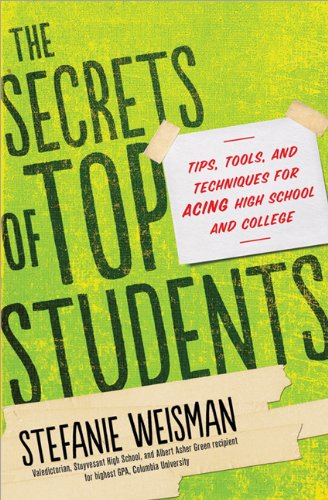
The Secrets of Top Students
Hey all you students and parents out there! Since it’s almost back-to-school time, I am giving away a copy of The Secrets of Top Students: Tips, Tools, and Techniques for Acing High School and College. All you have to do is click here to enter.
About the book:
The Secrets of Top Students includes tips and techniques that every student should know. For example:
Written in a conversational, down-to-earth manner, The Secrets of Top Students shows you how to maximize your learning and get the grades you want. Filled with innovative, time-saving techniques, this book also includes advice on motivation, the mind-body connection, and technology inside and outside the classroom.
By James Hinton
 I was an older student with an anxiety issue. After spending time in the Army, including several combat tours, I had been diagnosed with PTSD. Being around large numbers of strangers worried me. Noisy settings where I was not completely in control gave me the need to run for it. I would even feel a touch agoraphobic if I was not close to something I could bunker up within.
When I made the decision to obtain a college degree after getting out, these all presented me with significant problems. While some of the university classes I participated in had relatively small class sizes that enabled me to learn faces fairly quickly and find a certain degree of comfort with, large classes were a daily struggle. I would have to position myself close to doors so I could bolt outside for relief if needed. More boisterous classes could result in frequent, embarrassing episodes where I just plain had to get out.
Eventually I made it through and obtained my Bachelors, but it was not a particularly easy or enjoyable process. My struggles had frequently led to my considering quitting, which had only caused the depression that comes with PTSD to get worse. Preparing for class had been an anxiety inducing process that involved my wondering whether I’d make it through to the end, or have to make a dash for the door yet again.
I still wonder sometimes how I made it to graduation.
Editor’s Note: The concept of learning styles is controversial. The views expressed in this article are those of the author, and do not necessarily reflect the views of this website.
By Cindy Boesel
A clash of learning styles can be one of the biggest setbacks in the learning process. That’s why it is important to discover the learning style that suits you the most. People are different, and every one of us requires a different kind of support, special attention to certain things or some alone time to acquire maximum information. The sooner you discover your natural learning predispositions, the better chance you have to successfully change your learning techniques. Let’s take a closer look at different learning styles and methods to recognize your preferences.
Learning styles
We distinguish seven major learning styles. Keep on reading to find out how to differentiate between them.

What’s your preferred learning style?
 Stefanie Weisman