GRE vs. the GMAT: Which Should You Take?

By Marcela De Vivo
Whether you’re still clutching your newly minted diploma, or have been in the workforce for a decade, getting a graduate degree can be a smart career move, especially in the world of business. If you’re looking to earn a Master’s or MBA, more standardized testing is in your near future. The GRE is required for most graduate school programs, but the GMAT is more likely to be the test needed for MBA programs. There are other major differences between the two tests, so pick one that suits your strengths. These tests are also much pricier and involve even more studying than the testing required for undergrad applications, so most students don’t take more than one. Make sure you pick the right test to help you get into the graduate program of your dreams.

This infographic by BenchPrep Inc. can help you decide between the GRE and GMAT. If you’re planning on getting an MBA, make sure that the schools of your choice will accept a GRE instead of a GMAT, as not all schools accept GREs in place of GMATs. If you have stronger math skills than writing ability, the GMAT may be better suited to your proficiencies. Take a look at the major differences below.

benchprepgre


You need great grades to get into grad school.  The Secrets of Top Students can help you get there!

The Secrets of Top Students Book Signing

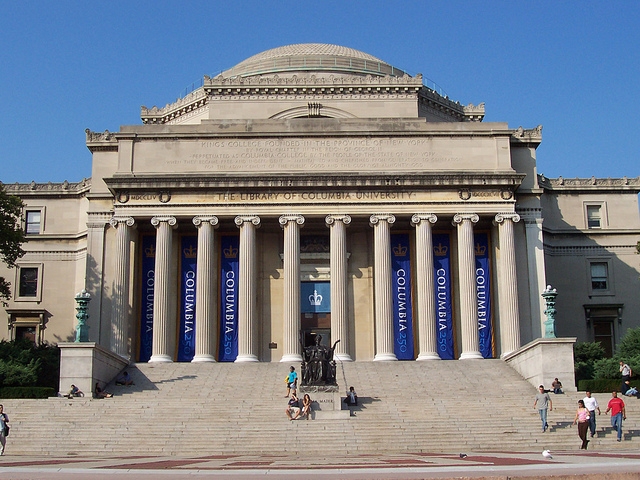
Photo of Columbia University, courtesy of InSapphoWeTrust via Flickr

Photo of Columbia University, courtesy of InSapphoWeTrust via Flickr

I’m excited to announce that I’m doing a book signing for The Secrets of Top Students at the Columbia University Bookstore on Thursday, September 19, at 6 pm. I’ll also be sharing some of my top study tips for high school and college students!  This is a great event for parents and students in the NYC area.

The Columbia University Bookstore is located at 2922 Broadway, Lerner Hall (114th St.), New York, NY 10027. Hope to see you there!

What’s the Best Music to Help You Study? (Guest Post)

While a lot of people work best in complete silence, there are many who prefer some form of background noise or stimulation in order to concentrate.

If you’re a college or graduate student who puts in long hours of studying, listening to music that you enjoy can help pass the time and allow you to concentrate on your work without getting bored.

Depending on your personality and the way your brain functions, there’s a high probability that certain types of music will help you pay attention and improve your study sessions.

The question is: What type of music will do that?

musicsession1

It’s obvious that certain musical genres are just plain distracting, emotionally charged, and not designed for concentration or relaxing. But there’s also a lot of music that can help you relax, focus, and be great accompaniment to a long study session.

While everyone’s different, here’s what I recommend for studying and concentration:

1. Lite jazz — Any kind of jazz will do, but vocal artists like Ella Fitzgerald or Sammy Davis Jr. are great for relaxing and focusing on your work. If you’re looking for something a little more upbeat, jazz fusion will have more of a pop sound and syncopated rhythm.

2. Classical — Classical music of any kind is a fantastic study companion. Not only does it sharpen your brain, but it’s easy to listen to and doesn’t distract you from other thoughts. If you were hoping for something a little more interesting than the average classical recording, try something like Perpetual Motion by Bela Fleck. He does a bunch of classical numbers on that album with a banjo.

3. Varied instrumental — Hearing other words can compete for your thoughts and make it harder for you to read or think through your own words. That means that instrumental tunes of most varieties are going to be better options for your study time.

Even heavier guitar stuff from Joe Satriani or Eric Johnson can make great studying tracks. Something more subtle, like an instrumental jazz or blues record, is also great for relaxing and concentrating.

4. Funk — Again, lots of instrumental options here, and a little more upbeat. Perhaps it’s not the most calm and soothing style of music, but it is smooth and can be a relaxing sound, even when you’re trying to concentrate on something else.

Helping you Relax

Music is helpful during a study session because it can help you relax, and while some people’s minds perform better with silence, music can be used as a tool to increase the length of time you’re able to focus on something.

If you want to try the music mentioned above, here are some sites where you can stream songs without having to pay for them.

1. Grooveshark — A form of social media for music lovers, Grooveshark allows you to search for music, create playlists, save them and then listen to them whenever you want. They’ve got just about every artist on the planet to choose from.

2. Arena — It’s similar to Grooveshark, but Arena puts more emphasis on the news and community aspect of streaming music. Arena also boosts the highest payout to artists per stream. You can search for music and make playlists.

3. Pandora — Pandora is designed to help you find new music that you’re more likely to enjoy, by letting you create stations based on artists that you already like. Once you select an artist, Pandora will play music similar to that artist. It’s not as “selective” as your other two options, but it will run on its own without the need to create a playlist; just select the initial band and you’re good to go.

Marcela De Vivo is a freelance writer and online marketing professional in the Los Angeles area. When she is trying to power through a long day at work, she enjoys creating a playlist to get her through. Follow her on Twitter today!


For more tips on how to study and much more, order your copy of The Secrets of Top Students today!

Summer 2013 Update

A lot of my articles have been popping up on the internet recently, and I wanted to share some of them here.

1. What Motivates Top Students? Getting Into the Heads of High Achievers, HackCollege.
What I learned about academic success, from my own experience as well as from my survey of forty-five of the best students in the country.

2. Struggling to be heard: What it’s like to be a student who stutters, USA Today College.
An account of my struggle with stuttering in high school and college, how I overcame it, and what to do if you stutter or meet a person who stutters.

3. I Got the Highest GPA at an Ivy, But Not Because I’m Smarter Than Everyone Else, Your Teen for Parents.
Some surprising facts about top students and how they got that way.

My book, The Secrets of Top Students, has also received some great reviews lately. I was especially thrilled with this one from the School Library Journal: “…the book is a must-read for students in middle school and up, teachers, parents, and guidance counselors as 21st-century students learn to excel in the new educational landscape in which they find themselves.”

On a completely separate note, a funny article I wrote a few months ago, The Top 6 Reasons You Should Date a Pilot, has been Liked over 14,000 times on Facebook!

How Stuyvesant Influenced My Writing Career

On Sunday, June 23, I was honored to participate in the “Writer’s Block” event at the Stuyvesant High School all-class reunion, along with eight other writers who are Stuy alumni: Richard (R.B.) Bernstein, Robert Timberg, Joe Dorinson, Peter Wortsman, Eugene Schlanger, Rebecca Pawel, Richard Herschlag, and Becky Cooper. They asked us to talk about things like the road to publication and the impact Stuyvesant has had on our writing careers. I thought I would include the questions that were asked, along with a summary of my answers.

The Secrets of Top Students

The Secrets of Top Students

(1) Tell us a little bit about your work (most recent or favorite) and what inspired you to write the book? Include why you choose the genre you did.

I just came out with my first book, The Secrets of Top Students. It’s an advice book for high school and college students on how to succeed in school. I was inspired to write this book because I felt like I had so much to share with other students. I’ve been a top student all my life – I was valedictorian of Stuy, class of ’99. I graduated from Columbia with the highest GPA in my class. I also have experience in a wide range of subjects – I have a B.A. in History, an M.A. in Art History, and a B.S. in Computer Science. Over the years I developed lots of techniques that helped me excel in school, and it just felt natural for me to write this book and share those techniques.

(2) What is your writing practice?

I just write whenever I can. My mind is usually the clearest in the morning, so I’m most productive then. I usually write at home, but I write outside whenever I can. I’m a pretty slow writer. I write a few pages, and then I spend a lot of time editing. Some days I’m much more productive than others.

(3) Describe the road to publication, from idea to release.

This idea started when I was getting my last degree, a B.S. in Computer Science from Columbia. I started writing down all the techniques that I was using, and all the things that my classmates were doing wrong – things like cramming for tests, not taking enough notes, not managing their time well, not asking for clarification, etc. After I graduated I wrote the first three chapters, did a lot of research, and surveyed forty-five other top students to get their insight into what it takes to be a top student. These people are Rhodes scholars, Goldwater scholars, Fulbright recipients, students at top law and medical schools, and even a National Spelling Bee winner. A few months later I got an agent, Coleen O’Shea, and she helped me find a publisher/ get a book contract. It then took me a few more months to finish the book, which came out in May. The whole process, from idea to publication, took 4 or 5 years – but the idea was gestating for a long time.

(4) Describe how you went about finding an agent and how you went about finding a publisher or decided to self-publish?

I got a book called The Writer’s Market, which has a great listing of literary agents. I sent query letters to agents who accepted non-fiction books, and luckily I got one! She helped me work on my platform and create a book proposal. Then she submitted my proposal to a couple of publishers. I had phone interviews with a few of them, and Sourcebooks gave me a contract! I was really happy because Sourcebooks has a great education division. They publish books like The Fiske Guide to Colleges and Gruber’s Test Prep series.

(5) Was there a Stuyvesant Muse? Describe whether attending Stuyvesant High School had an impact on your writing endeavors.

I wouldn’t be here today without Stuyvesant. I learned how to be a great student here. Stuyvesant has such high standards, and the student body is so talented, that I had to develop powerful techniques to succeed. I’m sure many of you will agree with me that college was relatively easy compared to Stuyvesant. And of course, being valedictorian of Stuyvesant has a certain cachet that helped me get a book contract in the first place.

I’m not sure if I would use the term muse, but I was really inspired by Dr. Nikol, who taught AP European History. He was a great story-teller and made history come alive, as they say. I remember I did pretty poorly on the first few tests in his class because they were so detailed, and I had to readjust/ refine my study habits. He was one of the most demanding teachers I had here, but I learned so much. He was a big part of the reason why I specialized in medieval European History at Columbia. I still have a love of history, and that’s why I’m writing a historical fiction novel set on Crete during the time of the Minoans, which is currently a finalist in the James Jones First Novel Contest.

A book review that warmed an author’s heart

Every once in a while, someone says something about my book that makes all the hard work I put into it worthwhile, and makes me feel like I truly accomplished something. I received such a review today, from someone called Stew Mulligan. I was so excited about it, I had to reprint it on my blog. The original review can be found here. Thank you Stew Mulligan, wherever you are!

The author and her book

The author and her book

“The Secrets of Top Students, by Stefanie Weisman, is a great book!

As a Stuyvesant High School alumnus, I know what it means to be that school’s valedictorian. Stuyvesant is not just any high school. It is a school that if you become a doctor you are considered an underachiever. They expect you to at least become head of a department in a major hospital or medical school. Stuyvesant graduate David Axelrod, is ONLY an advisor to the President; Stuyvesantian Eric Holder, is US Attorney General: not bad, but not a Supreme Court Justice. It’s where if you get 800 on your math SAT nobody lifts an eye. But in all seriousness, this is a school of really, really smart kids and, as such, I am awed by Stefanie’s academic accomplishments — not only the Stuyvesant valedictorian but she also graduated with the highest GPA from Columbia College. That’s like being the baseball Rookie of the Year and then following up by winning the MVP and Triple Crown. Stefanie knows how to hit academia’s fast ball, curve and knuckleball, and all for homeruns.

As a rule, if you want to learn something well, it is a good idea to learn from the best, and Stefanie Weisman’s Secrets of Top Students is now THE SOURCE on how to maneuver through the obstacle course of higher education. I guarantee that this book will not disappoint.

If school, in general, and tests, term papers and the like, in particular, give you anxiety attacks, then this book is definitely the relaxant. By all rights, Stefanie should never have become valedictorian. In fact, she probably should have been mediocre at best, since she has a certain learning disability. But by putting excuses aside, she learned how to use her strengths to overcome her weaknesses, by developing a relatively simple system of studying. In Secrets of Top Students she conveys her system, no longer secrets, in a clear and concise manner. And, I might add, with a particularly droll and somewhat self-effacing sense of humor. In other words, she explains how to walk the walk, how to traverse through the killing fields of the classrooms with the least possible pain and suffering. She explains how to avoid being an academic casualty or also-ran and to get through it all, knowing you did the best you can, while actualizing your potential.

This is not a textbook. But it tells how to penetrate the textbooks. This is not a lecture, but it tells how to absorb and retain what the lecturer is “trying” to expound. Being smart is not enough. You have to know how to learn. This book shows how to do it in an efficient and intelligent manner. Stefanie’s prose is concise and easy to follow and the book develops in a logical manner. (It ends with a chapter on “How to Take a Test”, by the way, since test taking is where the rubber meets the road.) The use of well placed bullet points and bold font help to highlight the most important concepts. At the same time, the book makes clear that there are individual differences, and that students have to make adjustments in their own studying methods that work best for them. Nevertheless, these basic concepts are still applicable, to different degrees and with different emphasis, to all types of learners.

Nor does the book sugar-coat the reality. It tells it like it is, which is to say that the most important thing in becoming a good, or a great student, is commitment and a willingness to work hard, damn hard. There is no easy way. There is only a EASIER WAY, a SMARTER WAY. This book is the roadmap.

I guess my only complaint, after reading this book, is that it was published 40 odd years too late. If only there had been a Stefanie Weisman to write such a book for us baby boomers, to help us get through the morass known as education, like a machete in a rain forest, who knows what grades I would have gotten. But today, 2013, if you are a young person wanting to maximize your potential in school, or if you are a parent of a student and would like to see your child rise to the top, take my advice and go out and purchase this book ASAP.”

Renting Versus Buying Your Textbooks Online (Guest Post)

The cost of textbooks can stack up quickly. Your net gain at the end of a school year, in either money or time, needs to be taken into consideration before you make a purchase.

At times, your textbooks will be worth buying and keeping. For instance, you may know you will want to keep those great, classic literary works from an English class. For other classes, books make solid references in the future when you want to brush up on basic material.

On the other hand, it may be easier for you to find a student on campus or online who is taking the course the following year who you can sell your textbooks to at an equal (or near equal) cost of your purchasing price.

You can purchase used editions of your textbooks at affordable prices at a site like amazon.com.

If you decide in the future to sell your book, buybacktextbooks.com is a useful resource for finding online bookstores offering the best buy back prices.

At the same time, keep in mind that some textbooks can get outdated quickly. As information and ideas change, many publishers can shell out new editions of their textbooks yearly. This happens often with many science-based course textbooks.

If this is the case, it may be easier to rent your textbooks online, rather than purchasing them. Oftentimes, with renting, you save more than half of the purchasing price.

Sites like chegg.com and campusbookrentals.com have hassle-free purchase and return policies. They also have a wide selection of books that are commonly used in classrooms.

For both sites, if for any reason you do not need the book you rented, you can return it to them within 21 days and 30 days, respectively, for a full refund (minus the cost of shipping). If there is an online version of your book, many sites offer you access to the online version while you wait for the physical book to arrive.

Not only do you save money when you rent your textbooks, but you do not have to worry about finding a buyer for your textbook or your book becoming devalued at the end of the semester.

It would be a good idea to check beforehand with your professors about their leniency with textbook editions. They usually understand the hefty price tag of their textbooks and do not require that you purchase the latest edition. You can also check-in with former students if it would be worth purchasing a textbook as opposed to renting it.

Know your budget and know what you want to get out of your course and your textbook.

If you know you are not going to use the textbook again and don’t want it to take up space in your home, or if you do not want to spend the time and effort of finding a buyer for your textbooks online or in person after what you know is going to be a long semester, renting your textbooks online is your best bet for saving money.

Marcela De Vivo is a freelance writer from Los Angeles who writes on everything from health and medicine to technology and travel. She currently writes for HostPapa and has seen firsthand how renting textbooks can be a great way to go while on a budget.


Give yourself the gift of great grades.  Order your copy of The Secrets of Top Students today!

Do’s and Don’ts for How to Focus While Studying (Guest Post)

Guest Post by Katherine Laramie.
Katherine is a freelance writer who lives in Orlando, Florida.

Your textbook is open, your notes are out and a highlighter rests in your hand. You have an upcoming exam and the best of intentions to prepare for it. After reading one paragraph, your mind starts to wander and somewhere between understanding “fundamental visual development principles” and “thematic and design ideas using visual media,” you’re on Facebook, and it’s not where you should be. It hasn’t even been 20 minutes, and you’re shutting that book thinking, “I’ll study tomorrow.”

In David Glenn’s essay “Procrastination in College Students is a Marker for Unhealthy Behaviors” in The Chronicle of Higher Education, procrastination is referred to as “anxiety avoidance” and “self-defeating behavior.” The article suggests that procrastinators are less worried about future success or failure, and says they experience high anxiety because of the negative feelings associated with committing to a night of doing schoolwork. If you’re guilty of postponing your studies, “wishful thinking” and “rationalizations,” then the following tips may help you improve your performance for a class or achieve that online art degree.

photo by xb3

Disassociating Anxiety from Studying & Test-Taking

Your future depends on graduating from school. Graduation depends on passing classes. Passing classes depends on high exam scores. Scoring highly on an exam depends on excellent studying skills. Ah, the anxiety sets in. Physiological stress follows. Failed attempts at studying are the end result. By eliminating the anxiety that’s associated with school work, you can eliminate subsequent negative, self-defeating feelings that disrupt your academic focus and obligations.

As you blindly stare at a power point on your laptop or gaze at a textbook, create positive associations with studying. Combat procrastination with the following tips:

  • Free your mind from external stressors, agendas and obligations.
  • Remind yourself that you’re nurturing your brain and acquiring knowledge. Embrace that you’re educating yourself. You actually want to improve your mind with this subject matter.
  • Focus less on the exam. By putting less emphasis on scoring highly, you’re alleviating yourself of pressure — and thus anxiety that pushes you to delay your studies for another day.
  • Replace rationalizations and wishful thinking. To handle the negative feelings associated with studying, you may respond by making excuses. Take accountability for your responsibilities and self-defeating behavior. Replace rationalizations, such as “I’m really tired tonight and not even retaining any information anyway,” with “I’m going to maximize my time this evening. There’s no better time than now to prepare for my upcoming exam. Cramming only stresses me out.”

Refocusing: It’s Never Too Late

Losing focus and succumbing to distractions is natural and to be expected while studying. Don’t be defeated by these moments of weakness, which can manifest into negative thoughts and abandoned studying. Take a small break, breathe and get back in the game.

Re-focus by:

  • Changing your scenery and location. If you’re at home, move to a different room. If you’re at the library, change floors and desks.
  • Drinking water. Hydrate and refresh your mind and body.
  • Playing music. The soothing and calming music of cellist Yo-Yo Ma can provide new sensory that re-energizes your studying.

Editor’s Note: My new book, The Secrets of Top Students, contains lots of advice on how to study for exams and avoid procrastination. Order it now on Amazon!


For more tips on studying and much more, order your copy of The Secrets of Top Students today!

New Book Reveals How to Get Better Grades

The following is my book’s official press release.  It’s getting closer!

Secrets of Top Students

Valedictorian Reveals Secrets to Being a Top Student

New Study Aid Features Straight Talk and Practical Advice on Making the Grade

Stefanie Weisman is the epitome of the successful student—valedictorian at Stuyvesant High School and recipient of the Albert Asher Green Prize for the highest GPA in her graduating class at Columbia University, among other honors.

How did she achieve academic success?

It may be surprising to learn that Weisman developed the skills that led her to become a top student because of an undiagnosed learning disability in which she struggled with listening comprehension.

Weisman, along with top students including valedictorians, Rhodes and Fulbright scholars, and even a National Spelling Bee champ, shares learning tips and techniques in her forthcoming book, The Secrets of Top Students: Tips, Tools, and Techniques for Acing High School and College (ISBN: 9781402280795; MAY 7, 2013; $14.99 U.S.; Study Aids; Trade Paper).

Weisman contends that being a top student is a lifestyle and outlines practical strategies for studying smart, learning well, and staying motivated.

The Secrets of Top Students features a holistic approach to learning that includes:

  • How sleep, diet, and exercise can affect a student’s GPA
  • What motivates top students to academic success
  • 50 “Grade A” test-taking tips
  • Three game-changing learning techniques
  • The trick to taking killer notes and improving reading comprehension

Written in a conversational, down-to-earth tone, The Secrets of Top Students shows students how to maximize learning and get the grades they want.


About the Author: Stefanie Weisman was born and raised in Queens, New York. She was valedictorian of Stuyvesant High School and graduated from Columbia University with the highest GPA in her class. She has a B.A. in history, a B.S. in computer science, and an M.A. in art history.  Stefanie has received numerous awards including Best Performance in Columbia’s Core Curriculum, Best Senior Thesis in History on a non-U.S. Topic, Phi Beta Kappa, and Summa Cum Laude.  She was a Craig Hugh Smyth fellow at NYU’s Institute of Fine Arts, where she specialized in ancient Greek and Roman art. She works in the technology industry in New York City. https://valedictoriansguide.com/

Media Contact: Liz Kelsch – Asst. Publicity Manager – 630-536-0595 – liz.kelsch@sourcebooks.com